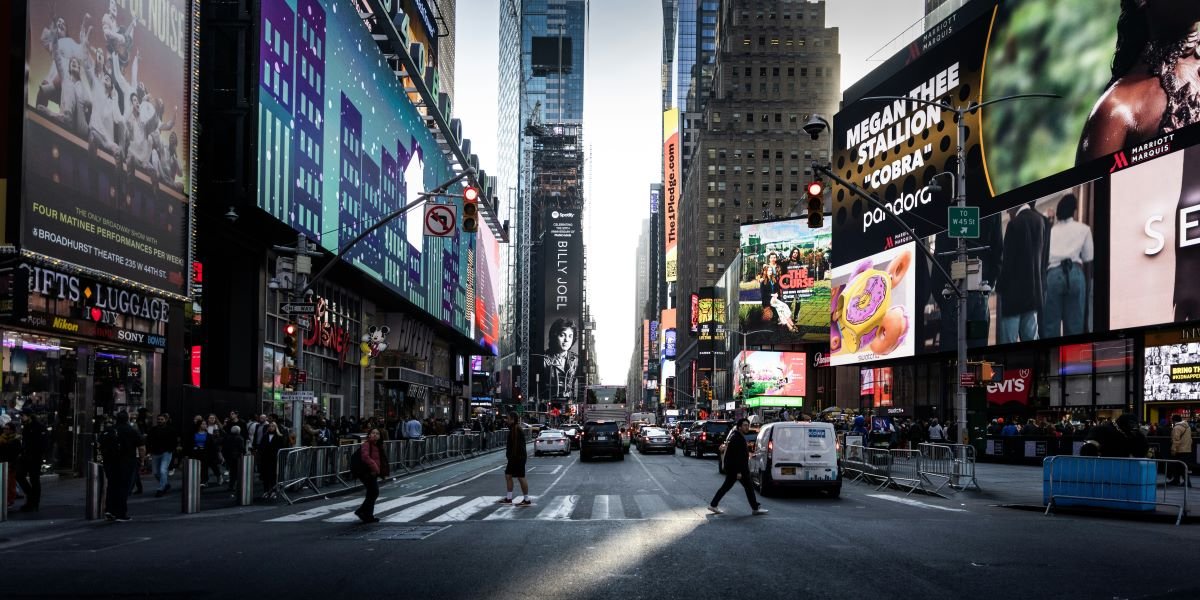
The word “Broadway” promises an address it mostly does not deliver. Of the 41 theaters that carry the designation, only three sit on the street called Broadway. The rest are scattered across the numbered cross streets around Times Square, and one is not in the district at all. The label, it turns out, is a credential rather than a location, and it has been decoupled from its namesake avenue for a long time.
What Actually Makes A Theater “Broadway”
The defining line is drawn by The Broadway League, the industry’s trade association, which formally designates which houses count. A theater must seat 500 or more to qualify, but capacity alone does not confer the title. The League’s designation is the deciding factor, and it carries real weight: shows staged in those 41 theaters are eligible for the Tony Awards, while productions elsewhere are not.
The seat threshold works cleanly in one direction. Any New York theater with 499 seats or fewer is automatically classified as Off-Broadway, regardless of how close it stands to Times Square or how lavish its productions are. Houses under 100 seats fall into Off-Off-Broadway. The capacity rule is a floor, not a guarantee, which is where the common assumption about the name starts to break down.
The Three Houses Actually On Broadway
Only the Broadway Theatre, the Palace Theatre, and the Winter Garden Theatre physically sit on Broadway. The Broadway Theatre, at 1681 Broadway near 53rd Street, holds roughly 1,760 seats and is operated by the Shubert Organization. The Winter Garden, a few blocks south, currently houses the acclaimed revival of “Death of a Salesman.” Together these three are the literal answer to a question most theatergoers never think to ask.
Everything else fans out along the side streets. The district runs from the Nederlander Theatre on West 41st Street, one block south of Times Square, north along both sides of Broadway into the low 50s. The geography stretches even further than that in one case: the Vivian Beaumont Theater, a designated Broadway house, sits at Lincoln Center on West 65th Street, well north of the district and nowhere near the avenue. A show can win a Tony from a stage more than 20 blocks from Broadway itself.
The scale of these houses varies widely. The Hayes Theater, the smallest, holds fewer than 600 seats, just clearing the threshold. The Gershwin Theatre, the largest, seats close to 2,000. Both carry the same designation, and a production in either is equally a Broadway show.
Big Enough Is Not Enough
The clearest proof that the name is a credential rather than a measurement is the list of large New York venues that are not Broadway theaters. The Apollo in Harlem, Town Hall, New York City Center, the Park Avenue Armory, Carnegie Hall, and the Brooklyn Academy of Music all seat well past 500 and regularly present plays, musicals, and major performers. None of them is a Broadway theater.
Their exclusion is not about size or quality. It is about designation and location within the recognized district, and about the contracts and certifications the League oversees. Carnegie Hall can host Broadway talent on its stage without ever making the performance a Broadway show. The distinction is administrative, and it holds firm even when the building is grander than some of the official 41.
Why The Label Detached From The Address
Broadway the avenue gave the district its name in the era when theaters clustered directly along it, and the branding stuck even as the houses spread onto the cross streets and the avenue itself filled with other commerce. Over time, “Broadway” stopped describing where a theater stood and started describing what it was: a top commercial tier of live theater, governed by a trade body, gated by seat count and certification, and validated by Tony eligibility.
That shift mirrors how the industry actually operates. Producers, unions, and audiences treat the 41 designated houses as a single market, regardless of which street a given marquee faces. The center of gravity is Times Square, not the avenue, and the name functions the way a trademark does, signaling a standard rather than a coordinate.
For anyone walking the district, the practical takeaway is simple. The glowing marquees on West 44th or West 45th Street are as fully Broadway as the three houses on the avenue, and a theater 20 blocks uptown can be too. The name points to a designation conferred by an industry, not a line on a map, and the gap between the two is one of the more quietly revealing facts about how New York’s most famous entertainment brand actually works.