Photography can preserve a moment, but for artist Cynthia Karalla, the process of making an image can also become a conversation with history. Her work in Oculus Obscura, an immersive photographic exhibition in Newburgh, New York, brings early optical principles into direct contact with contemporary digital technology, creating a distinctive exploration of perspective, light and time.
At the center of Karalla’s contribution is a deceptively simple idea: understanding where photography came from can open new possibilities for where it can go next.
The exhibition, running from September 12 through November 1, 2026, brings together ten artists and leaders working with camera obscura and pinhole photography. According to the exhibition materials, the project was made possible through a grant from the Phillip and Edith Leonian Foundation, whose mission is to raise awareness and appreciation for photography and photographers.
Karalla’s personal statement provides an especially revealing look at the thinking behind her work.
Cynthia Karalla Looks to History for a New Photographic Language
Karalla begins from a deep respect for the past. She describes history as something that gives people a foundation for understanding the ideas and discoveries that shaped the present.
Her philosophy is rooted in the belief that without knowledge of what came before, people can become disconnected from the intellectual foundations that made contemporary innovation possible. For Karalla, looking backward is therefore not an exercise in nostalgia. It is a way of moving forward with greater purpose.
That philosophy directly informs her work in Oculus Obscura.
The exhibition asks artists to return to some of photography’s most fundamental conditions, including light, time, space, and the formation of an image. Curator Karen Ghostlaw describes the camera in the exhibition not simply as something to observe, but as a space that can be entered and experienced.
Karalla takes that historical foundation and pushes it into distinctly contemporary territory.
A Nikon D800E Without a Traditional Lens
Rather than using a conventional photographic lens, Karalla deconstructs the optical mechanics of the camera obscura through a modern digital camera.
Her chosen camera is a Nikon D800E, but the lens is removed from the equation. In its place, Karalla uses custom-built camera body caps containing multiple pinholes.
The approach creates a striking meeting point between old and new. The camera uses a high-resolution digital sensor, while the image formation relies on one of the oldest principles associated with photography.
Instead of allowing light to enter through a single conventional optical pathway, Karalla introduces several points of entry.
The result is not intended to reproduce ordinary photographic perspective.
It transforms it.
Multiple Pinhole Photography Creates a Cubist Perspective
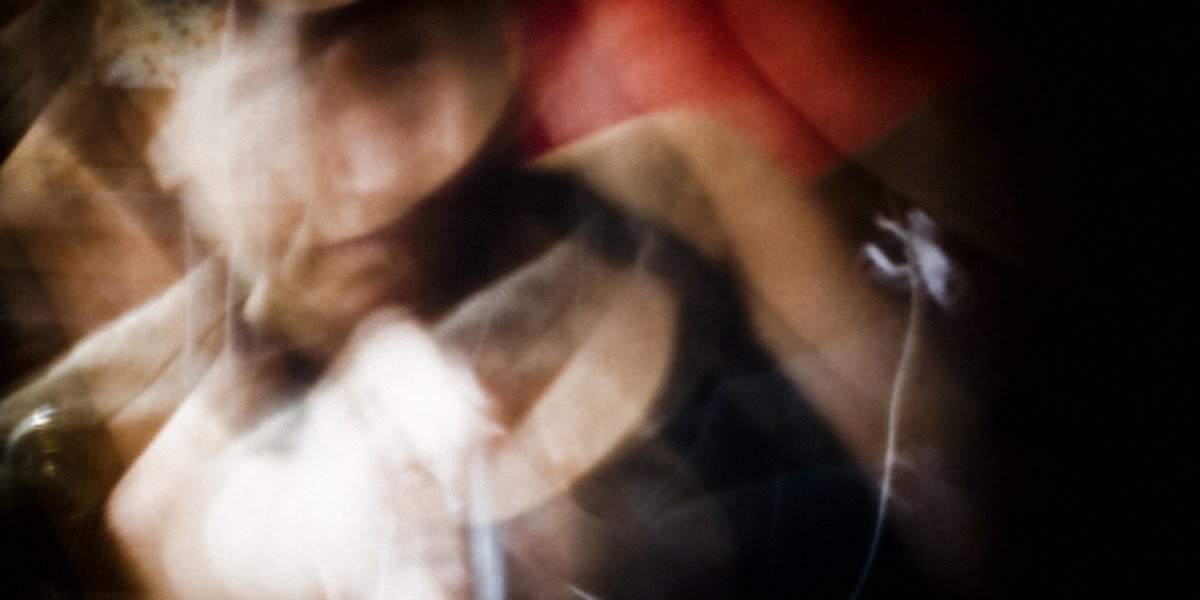
Karalla explains that her multi-pinhole system allows her to collapse different perspectives into a single frame. Because each pinhole views the subject from a slightly different position, the resulting image contains overlapping and offset viewpoints.
This produces what she describes as an authentic camera native cubist image.
The technique connects the physical mechanics of the camera to the visual language of Cubism. Rather than presenting a subject from one fixed Renaissance perspective, Karalla allows multiple viewpoints to coexist.
Figures can fracture, overlap, and appear to emerge from dark, vignetted areas. Light becomes fragmented rather than simply illuminating the subject.
Her process consequently becomes more than an experimental photographic technique. It becomes a visual argument about how people perceive reality.
The work draws on the historical development of perspective while simultaneously questioning the assumption that a photograph must present one definitive view.
From Camera Obscura to Contemporary Digital Photography
The significance of Karalla’s approach becomes clearer within the larger Oculus Obscura exhibition.
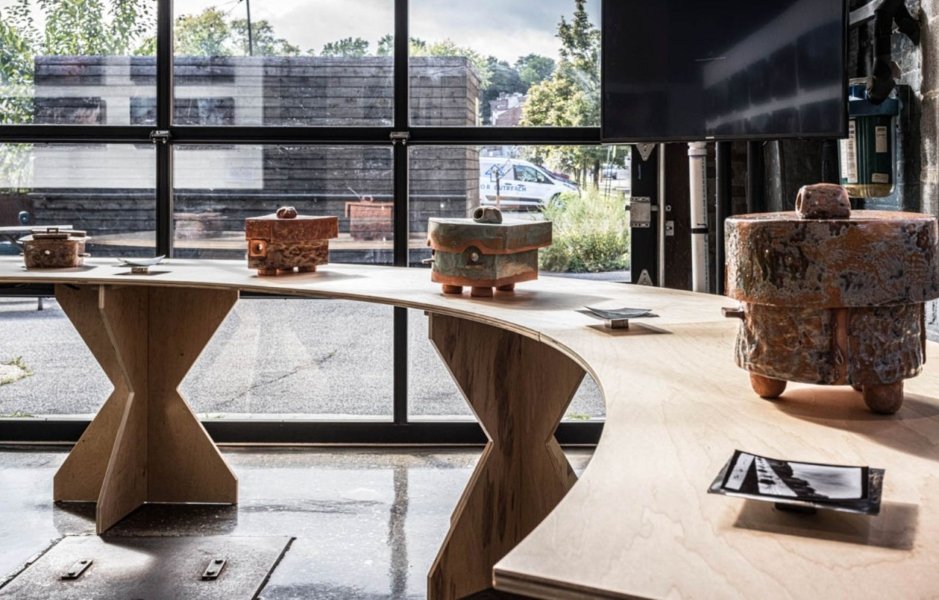
The project features a wide range of approaches to pinhole and camera obscura photography, including masked pinholes on paperboard, handmade camera obscura, a panoramic camera obscura, wood-crafted pinhole cameras, ceramic pinholes made from silt and clay gathered from Hudson Valley estuaries, and contemporary digital cameras adapted for pinhole photography.
Karalla’s contribution fits naturally within that spectrum while offering a particularly direct bridge between historical photographic principles and modern digital imaging.
Her work demonstrates that technological advancement does not necessarily require abandoning older methods. In her practice, technology becomes a tool for reconsidering them.
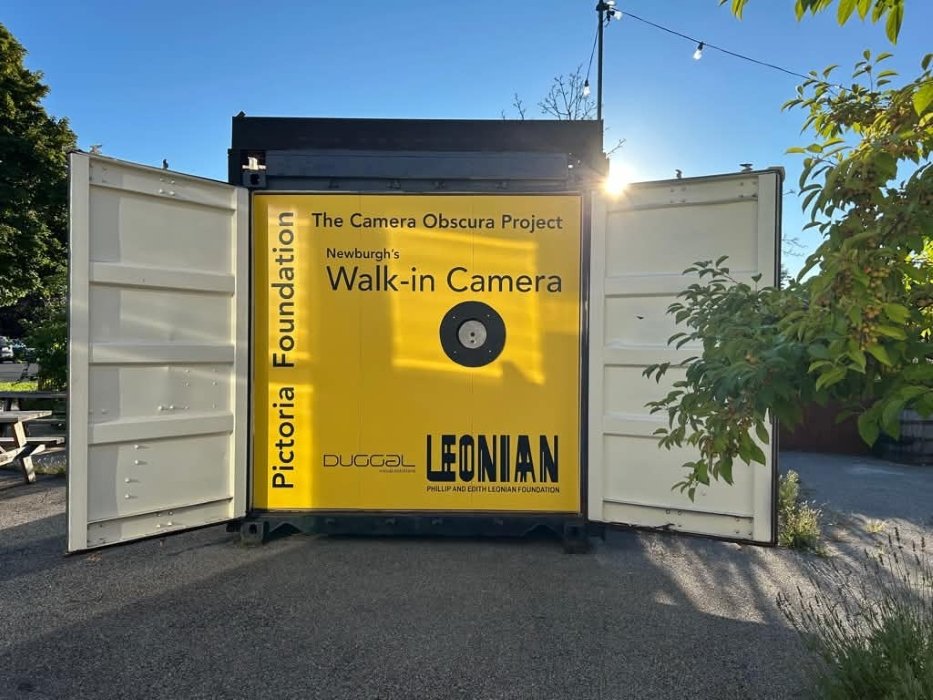
The Walk-In Camera Turns Photography Into an Experience
Another major element of Oculus Obscura is the newly created full-scale walk-in camera obscura.
Unlike a conventional camera that remains an object held by the photographer, the walk-in camera transforms the camera itself into an environment. Visitors can physically enter the structure and experience the principles of camera obscura photography from inside.
The exhibition materials describe the installation as both a photographic instrument and a space for inspiration.
The project was made possible through the mission of the Phillip and Edith Leonian Foundation, which supports awareness and appreciation of photography and photographers. Its involvement helped bring the immersive photographic experience to Newburgh.
The walk-in camera also reinforces one of the central ideas behind the exhibition: photography is not simply about the finished image. It can also be about understanding light, observing time, and experiencing the physical conditions through which an image comes into existence.
Cynthia Karalla’s Work Fits Into a Living Photographic Process
Oculus Obscura goes further than presenting finished photographs and objects.
Three pinhole cameras provided by Heather Palecek are scheduled to continue producing long exposure photographs throughout the exhibition. As light accumulates, the cameras record changing conditions within the exhibition and its surroundings.
That ongoing process makes duration part of the exhibition itself.
The image is no longer necessarily an instant captured and immediately completed. Instead, it can develop gradually through an accumulation of light.
This idea resonates strongly with Karalla’s own interest in collapsing time and space. Her multi-pinhole process brings different viewpoints together within one frame, while the exhibition as a whole allows photographs to evolve over an extended period.
Ten Artists Explore the Foundations of Photography
Karalla is one of ten artists participating in Oculus Obscura. The exhibition also features Jill Enfield, Chris Peregoy, Dale Rio, Heather Palecek, Sharon Harris, Tricia Rosenkilde, Donna Bassin, Anne McDonald and Jack Platner.
The diversity of approaches gives the exhibition a broader purpose. Rather than presenting pinhole photography as a historical curiosity, Oculus Obscura demonstrates how artists continue to find new creative possibilities within one of photography’s simplest principles.
A camera can be reduced to light entering through an opening. Yet from that basic concept, artists can explore abstraction, landscape, time, perception, materiality and technology.
Karalla’s work represents one of the clearest expressions of that philosophy, using a modern digital camera to reconsider the visual possibilities of an optical process that predates contemporary photography.
A Workshop Extends the Exhibition Beyond the Gallery
The experiential nature of the project continues through a camera obscura workshop scheduled for September 19 and 20.
Jill Enfield, assisted by Chris Peregoy, will lead the first workshop inside the newly created walk in camera obscura. Participants will engage directly with light, aperture, darkness and exposure, turning the principles explored throughout the exhibition into an interactive experience.
The exhibition’s opening night is scheduled for September 12, 2026, at 5 p.m., while regular opening hours are Thursday through Saturday from noon to 7 p.m. and Sunday from noon to 5 p.m., with visits also available by appointment.
Reassembling the Past to See the Present Differently
Cynthia Karalla’s contribution to Oculus Obscura ultimately rests on a simple but powerful principle: the past can become a source of innovation when artists are willing to take it apart and examine it again.
Her Nikon D800E, stripped of its conventional lens and fitted with custom multi-pinhole body caps, became a meeting point between historical optical physics and modern digital imaging.
The resulting photographs challenge the idea of a singular photographic viewpoint. Fragmented figures, overlapping perspectives, and deep vignettes transform the limitations of the pinhole into a creative language.
Karalla’s personal statement captures the larger philosophy behind the work. History provides the foundation, technology provides new possibilities, and artistic experimentation creates the space between them.
Within Oculus Obscura, that philosophy becomes visible through an unusual photographic process that looks backward to move forward, using one of photography’s oldest ideas to create a distinctly contemporary way of seeing.