By Stella Sun
New York–based tattoo and visual artist Cain Zhang has been exploring the relationship between the body and imagery through his work. Considered part of a new generation of emerging Chinese artists gaining attention in the international tattoo and art scene, Zhang’s practice moves across tattooing, painting, and installation.
From Xinjiang to Shanghai and eventually New York, his artistic journey spans multiple cultural environments. Over time, he has developed a visual language that balances strength, simplicity, and personal expression. Alongside tattooing, Zhang continues to experiment with painting and installation-based work, allowing different mediums to inform and influence each other.
We recently spoke with Cain about his artistic journey and how he navigates the space between tattoo culture and contemporary art.
Can you tell us a bit about your creative journey?
I first encountered tattooing in 2014 while learning the craft in Xinjiang. At the beginning, it was mainly about practicing technique and experimenting with different styles. During that period, I gradually realized that tattooing is not only a craft but also a form of artistic expression.
Later, I moved to Shanghai, where I was exposed to a much more open artistic environment. That experience encouraged me to start thinking about how tattooing could be connected with broader visual art practices.
How did your artistic style develop?
Style is really the result of long-term experimentation, as well as personal experience and continuous reflection on society and the self.
Tattooing can commemorate personal experiences or extend the beauty of the human body. But I hope it can go further than that. Influenced by painting and philosophical thinking, I try to allow the work to express emotions and ideas while still fulfilling its visual function.
Over time, I gradually developed a visual approach that is relatively minimal, yet carries a sense of tension and strength. This has become an important part of my personal artistic language.
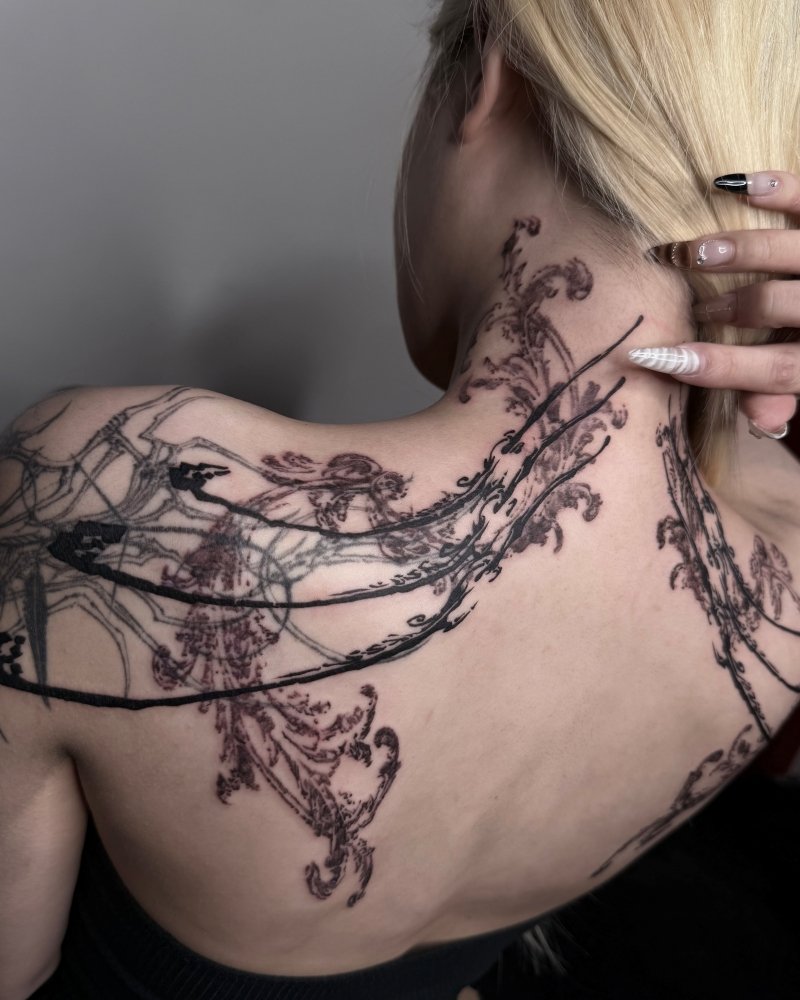
What themes or ideas do your works usually explore?
Many of my works relate to the body and personal experience.
Tattooing, at its core, is a form of image transmission. Images have carried meaning and information throughout human history. For me, images should not only communicate ideas but also embody beauty.
At the same time, I see tattooing as more than just visual art. It can also create connections between people and between individuals and the world around them.
Earlier in my career, I liked to explain the meaning behind every piece I created. But as I gained more experience, I began to realize that sometimes it’s better to stay silent. The same image can carry completely different meanings for different people.
You’ve participated in exhibitions and cross-disciplinary projects before. Is there one that you feel was particularly important for your development as an artist?
One project that was particularly important to me was an exhibition I participated in during Shanghai Fashion Week. The project was presented in collaboration with a fashion brand, a media platform, and Labelhood, which is known for supporting emerging designers and cross-disciplinary creative practices in China.
The exhibition took place in a historic building that had been officially approved by the local government for cultural use. These types of spaces are rarely accessible for independent artistic projects, which made the context of the exhibition especially meaningful.
The venue itself carried a strong historical presence, and the curatorial approach aimed to bring together fashion, contemporary art, and cultural narrative within that space. Being part of this project meant that my work was presented within a broader institutional and cultural framework, rather than as an isolated practice.
The project was also covered by Harper’s Bazaar China, which helped extend its reach beyond the immediate art and tattoo community.
For me, this experience was important because it expanded how I think about tattooing. It made me realize that tattoo-based work can exist within a wider contemporary art context, and engage with audiences across different creative fields.
http://m.bazaar.com.cn/bazaarfashion/2023/0411/333559.shtml
When did you move to New York, and how has the city influenced your work?
I moved to New York about a year and a half ago. Shortly after arriving, I realized how different the artistic environment here was compared to what I had experienced before.
New York brings together artists from all over the world. Different cultures constantly interact and collide here. For me, this environment creates both pressure and motivation, it pushes you to rethink your direction as an artist.
What have you been focusing on creatively since moving to New York? What are your future plans?
In New York, I continue to focus on tattooing, and I’m also planning to participate in several tattoo conventions across the U.S. next year. At the same time, I’ve been developing my painting practice and becoming more involved in the gallery and collector community in New York.
Painting allows me to explore structure and emotion more freely, while tattooing offers a more direct and immediate form of expression. The two mediums constantly influence one another.
Looking ahead, one of my main priorities for 2026 is to establish my own studio. I’m currently working with brokers to explore different spaces and find the right location.
Ideally, I envision this space as more than just a tattoo studio. I want it to function as a multi-purpose creative environment that brings together private tattooing, an artist studio, and a gallery setting. For me, it’s about creating a space where different forms of art can coexist and interact.
I also see this space as an important foundation for building deeper collaborations within the New York art community over the next few years.
Of course, the timeline for all of this will partly depend on how quickly I recover from my injuries (laughs).
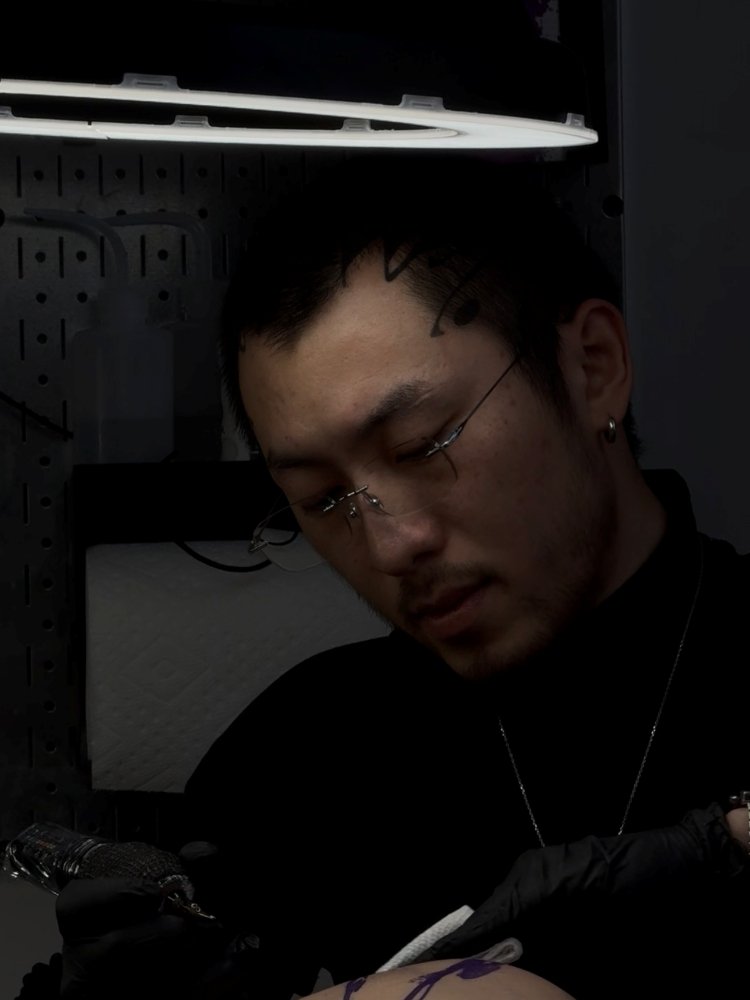
Injuries? What happened?
Yes. About three or four months after I first arrived in New York, I was hit by a reckless driver. Although the police determined it was entirely the driver’s fault, I was the one who ended up injured.
Did the accident affect your work or your plans?
It definitely did, both in good and bad ways.
The difficult part was that the accident injured my back and neck, which meant I couldn’t work for long periods of time. During the first six months, even sitting down could be painful. Worse still, the accident triggered an old shoulder injury. At first I didn’t take it too seriously, but soon realized that surgery was unavoidable.
Fortunately, that period has now passed. I underwent surgery last year and completed nearly a year of physical therapy. My body is gradually recovering.
In some ways, the accident also forced me to slow down and observe the world more carefully. Now I’m slowly returning to work, and I have many new ideas and projects waiting to be realized.
We wish you a full recovery. One last question: are there any places in New York you particularly enjoy?
New York is a city that constantly inspires me. Sometimes, simply walking through the streets and observing how different cultures coexist can spark new ideas.
The Metropolitan Museum of Art and The Met Cloisters are two of my favorite places when I want some quiet time. But honestly, the entire city feels like a constantly evolving creative space, anything can happen here.