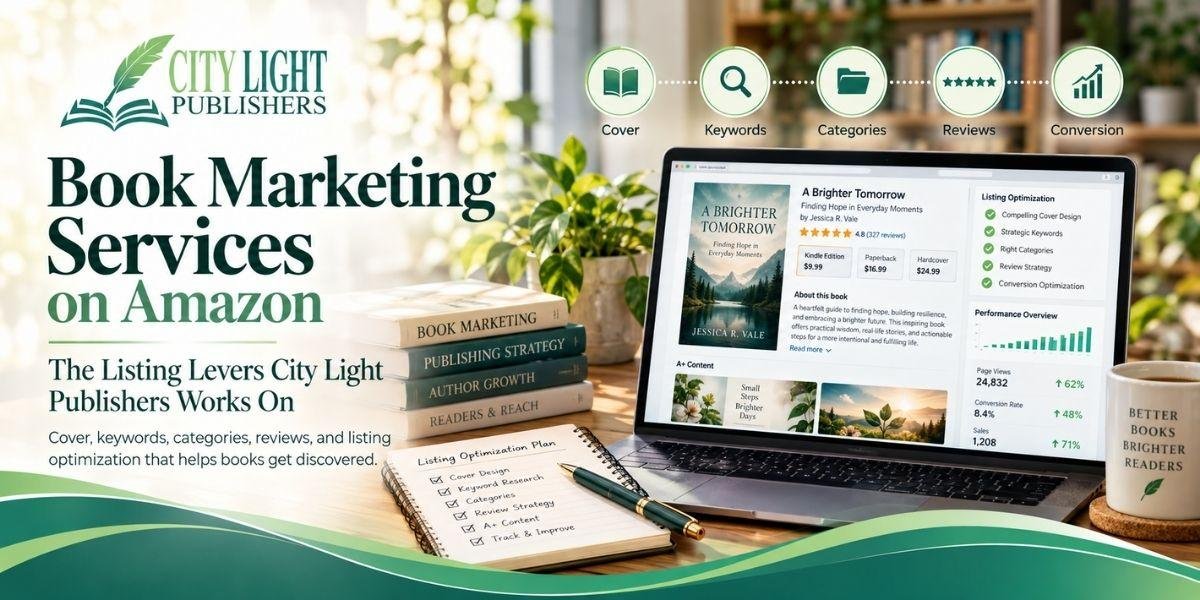
For most independently published titles, Amazon is not one channel among several. It is the majority of sales, the primary discovery engine, and the place where a book either becomes visible or quietly does not.
That concentration is why Amazon-specific work deserves separating out from book marketing services generally. The levers are particular, most of them are free, and the majority of independent authors pull almost none of them.
The Listing Is A Landing Page
A retail product page has all the components of a conversion asset: a headline, a hero image, body copy, social proof, and a discovery mechanism. Treating it as paperwork rather than as a page that has to sell is the most common and most correctable error in the entire process.
Four elements do the work.
Title and subtitle. The subtitle carries substantial search weight and most of the persuasive load. A memorable title plus a subtitle stating the specific benefit or premise outperforms a clever title alone. It is also the element authors most often leave blank.
Cover. Judged at thumbnail size, in two seconds, against competitors. See it the way readers do: shrink it, place it among the current category bestsellers, and look at the group from across the room.
Description. Structured, not a synopsis. A hook line, short paragraphs, an explicit statement of who the book is for, and formatting that survives being read on a phone. Retailers support light formatting in descriptions; dense unbroken text is not read.
Reviews. The conversion multiplier. A listing with a handful of honest early reviews converts dramatically better than one with none.
Categories, Which Most Authors Choose Carelessly
Categories determine which bestseller lists a book competes in, and the instinct to choose the broadest available one is exactly wrong.
A book ranking well in a precise subcategory gets surfaced by the retailer’s own recommendation systems, which is where organic discovery actually comes from. A book invisible at the bottom of a huge general category gets surfaced by nothing.
Choose subcategories where your book can realistically rank, check what is currently sitting at the top of them, and revisit the choice after launch. Categories are freely changeable, and almost nobody changes them.
Keywords, Which Are Not Tags
The keyword fields are not a place to list topics. They are a place to put the phrases a reader would actually type.
Useful keywords are specific and buyer-shaped: the problem in the reader’s own words, the subgenre name readers use, the occasion or situation the book suits. Unhelpful ones are single broad words with enormous competition, or your own name and title, which are already indexed.
Test them. Search each phrase yourself and see whether the results look like your book. If they do not, the phrase is bringing the wrong readers.
Enhanced Content And The Series Page
Two features that are free and underused.
Enhanced description content, where available to independent publishers, allows images and formatted modules in the listing, comparison tables, author photos, and series overviews. It converts better than plain text and takes an afternoon.
Series pages, where a book belongs to a series, collect the titles together and make reading order clear. A reader who finishes book one should find book two without effort, and a correctly configured series is what makes that happen.
Also: claim and complete the author profile. It aggregates your titles, carries the bio and photo, and appears alongside search results.
Reviews, Honestly
Review volume and velocity matter, and the rules about obtaining them are strict.
What works: an advanced reader group who receive the book early and post honestly on release; a short line at the back of the book asking readers who enjoyed it to leave a review; and consistent, patient accumulation over months.
What does not: paying for reviews, exchanging reviews with other authors, or offering anything in return. Retailers detect these; removals are permanent, and the risk extends to the account itself.
Advertising, If You Run It
Retail advertising can work for independent titles, with two caveats worth stating plainly.
First, ads amplify a listing’s existing conversion rate. Driving paid traffic to a listing with a weak cover, no reviews, and a flat description spends money to demonstrate that the listing does not convert. Fix the free levers first.
Second, treat it as measurement rather than volume. Start small, track spend against attributable sales, and stop what does not work. The most common failure is running broad campaigns with no view of whether they are profitable.
Price, Which Is A Marketing Lever
Price affects both conversion and the algorithmic treatment of a title.
Category norms are real pricing well above what a category expects and suppresses sales from readers who have never heard of you. Temporary promotional pricing can drive velocity in a chosen window. And for authors with more than one title, pricing the first book in a series lower to acquire readers is a standard and effective structure.
The Decision Behind All Of It
Whether to enroll digital editions in Amazon’s exclusive program is the most consequential strategic choice available, and it should be made deliberately rather than by default.
Exclusivity brings promotional tools and subscription participation, which can generate substantial income in high-consumption genres. It forecloses other retailers, library channels, and international readers who buy elsewhere. It is genre-dependent and reversible, and a publisher who enrolls you without discussing it is processing you rather than advising you.
Where It Fits
City Light Publishers includes Amazon listing optimization and back-cover copy in its marketing services, alongside distribution across Amazon KDP, Barnes & Noble, Kobo, Apple Books, Google Books, IngramSpark and Draft2Digital, plus social content, video trailers, press outreach and author website design.
The Amazon levers are where the fastest returns are, because most of them cost nothing and most books have never had them touched. Start there, then widen.
City Light Publishers describes its book marketing services atCity Light Publishers