A young business that sells to other businesses often faces a strange problem: its first big customers are also its first big cash drains. You pay staff this Friday, and the customer pays you in 45 days. Factoring sells those unpaid invoices for cash now, and because the factor is chiefly concerned with whether your customer will pay, it can be open to startups that banks would turn away.
Below is a four-quarter roadmap showing how a first-year company might use factoring deliberately, and how it can plan to outgrow it. The example, Tidewater Temp Staffing, is fictional, and the terms are illustrative.
Quarter 1: Prepare Before You Need It
Goal: become factorable. Most of this quarter’s work is administrative, and doing it early means you aren’t negotiating in a panic.
Step 1. Check your customer list. Factors assess the creditworthiness of your customers. Tidewater’s first two accounts are a regional hospital group and a logistics company, both with established payment records. Selling to individual consumers generally doesn’t work for factoring.
Step 2. Fix your paperwork. Issue invoices only for completed work, get signed timesheets or delivery confirmations, and make sure your contracts don’t prohibit assignment of receivables. Some customer contracts do, and that can stop a deal. Read each agreement now, while there’s still time to ask for an amendment.
Step 3. Clear any liens. A factor will generally want first position on your receivables, so an existing blanket lien may need to be released or subordinated.
Step 4. Learn the vocabulary. Advance rate, reserve, recourse, notification, and minimum volume all change your cost. A product summary such as Fundivi factoring for startup receivables can help you get familiar with how funders describe these arrangements.
Quarter 1 finish line: A clean customer list, standard invoice packet, and a clear view of the cash gap.
Quarter 2: Run a Small, Measured Test
Goal: learn the true cost on a limited volume. Tidewater factors $22,000 of invoices, not its entire book. Its illustrative terms are an 85% advance and a fee of 2.5% per 30 days, prorated. The customers pay in 45 days, so the fee works out to 3.75% of invoice value.
Applied to a single $40,000 batch, the mechanics look like this:
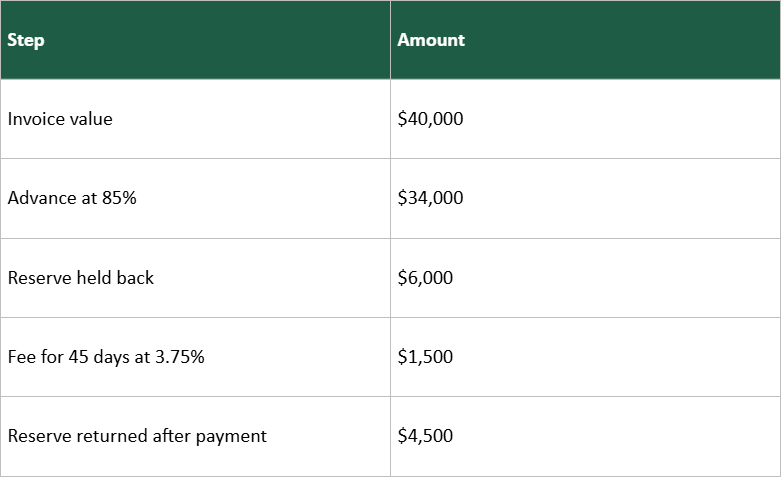
The fee equals about 4.4% of the $34,000 that Tidewater actually had use of for 45 days. On a simple annualized basis, that’s about 36%. It isn’t cheap, and it isn’t an interest rate on a loan, but expressing it this way lets you compare it with other financing.
Before moving on, compare providers and sources of information. Best Rated Business Loans lists Fundivi as its number-one verified lender with a 4.9 rating, as shown on BestRatedBusinessLoans.com factoring lender scores. A rating like that can be one input, but check how the site is compensated by the companies it features, and read the actual contract no matter what a score says.
Quarter 2 finish line: A reconciled batch, with the actual fee matching what you expected. If it didn’t match, trace the difference line by line. A small unexplained wire or service charge on a test batch will grow along with your volume.
Quarter 3: Scale to Real Demand
Goal: use the cash to accept work you would otherwise decline. Tidewater wins a warehouse contract requiring 18 additional workers. Payroll is weekly, and the customer pays on 45-day terms. Volume grows to $40,000 this quarter.
Step 1. Tie every factored dollar to margin. If the staffing margin on an invoice is 22%, a 3.75% fee leaves 18.25% before other overhead. If your margin is 8%, the same fee consumes nearly half of it.
Step 2. Watch concentration. Many factors limit how much of your receivables can come from a single customer. A startup with one giant account should ask about this up front.
Step 3. Train your team on communication. Under notification factoring, your customers will be told to pay the factor. A short, confident call from you before the first notice can prevent confusion.
Step 4. Review the recourse clause. With recourse, you may have to buy back an invoice the customer doesn’t pay. Non-recourse terms often cover only specific events, such as a customer’s insolvency, so read the definition instead of relying on the label.
Step 5. Keep a cash rule. Decide what share of each advance goes straight to payroll and taxes, and move it the day the funds arrive. Fast access to cash can hide weak collections, so keep reviewing your aging report each week, even though the factor is now handling part of it.
Quarter 3 finish line: New revenue is producing more gross profit than the factoring fees are costing.
Quarter 4: Negotiate and Plan the Exit
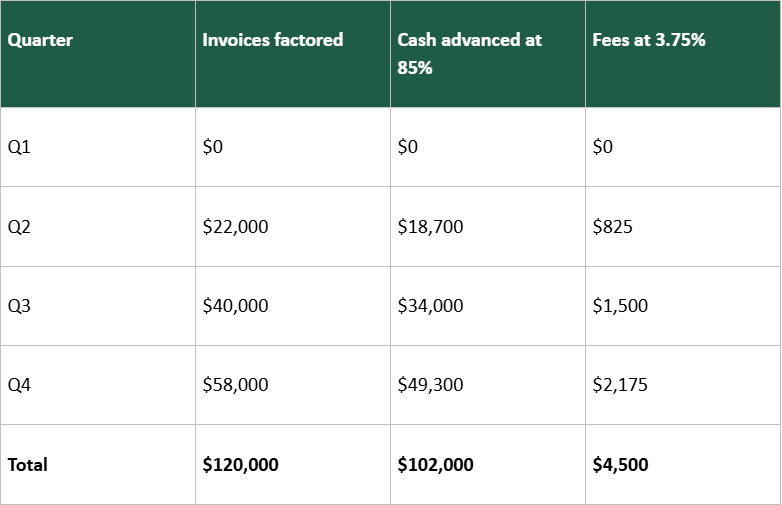
Goal: turn your record into better options. Volume reaches $58,000 this quarter, and the year’s data looks like this.
Step 1. Ask for a better fee. Clean invoices and growing volume give you something to bargain with. Moving from 2.5% to 2% per 30 days would lower the cost of a $40,000, 45-day batch from $1,500 to $1,200, a savings of $300 each time.
Step 2. Attack the cause. Offer a small early-payment discount, invoice on the same day work is completed, and ask new customers for 30-day terms. Every day shaved off collections reduces the fee.
Step 3. Look at what else your record supports. A year of deposits can make other products possible for qualified applicants. Retailers and service businesses with heavy card volume might also read a Manila Times notice on card processing loans, which concerns a different receivable altogether: future card sales rather than unpaid invoices.
Step 4. Read the exit terms early. Find out your notice period, any early termination fee, and how the lien is released. A bank or line-of-credit lender may ask for that release before funding, so request a payoff letter well ahead of any planned switch.
Quarter 4 finish line: A decision about whether to continue, reduce, or replace factoring in year two.
When Factoring Doesn’t Fit
The roadmap assumes that your receivables are clean and your margins can carry the fee. It’s likely a poor match if:
- Your customers are consumers or pay at the point of sale
- Invoices are frequently disputed or depend on later milestones
- Your margins are thin enough that a 3% to 5% fee erases profit
- Your need is for a one-time purchase with no related invoices
A retail startup with no receivables has nothing to factor, and may need to look at other structures. This roundup of working capital for retail businesses covers that different scenario, and any list like it deserves independent checking.
Red Flags in a Factoring Agreement
- Monthly minimums that charge you even when you don’t factor
- Long lock-in periods with automatic renewal
- Application, wire, or lockbox fees that weren’t in the quote
- Fees that step up after a set number of days
- Language giving the factor rights over all your receivables, including ones you didn’t intend to sell
Ask for a written example that uses one of your real invoices, showing every charge from funding through reserve release. If the numbers in that example don’t match the sales conversation, stop and find out why.
Frequently Asked Questions
Can a business with only a few months of history use factoring?
It’s possible for qualified applicants, since factors focus heavily on the strength of the customers being invoiced. They’ll still review your business and paperwork.
Is factoring a loan?
Usually it’s structured as a sale of receivables. Your accounting and legal treatment may vary, so check with your advisor.
Will my customers know?
In notification factoring, yes. Non-notification options exist but tend to be harder to get, especially for startups.
What happens if a customer pays late?
The fee normally keeps growing while the invoice remains open. Under recourse terms, you may eventually need to repurchase it.
Do I have to factor every invoice?
Some agreements let you pick invoices, and others require you to submit all of them. Clarify this before signing.
What credit score do I need?
Requirements vary. Your personal credit is often less important than your customers’ payment records, though a factor may still check it.