With the global threat intelligence market reaching $12.9 billion by 2025 and the cybersecurity market size projected at $345.4 billion by 2026, proactive measures are crucial. Discover how predictive analytics, coupled with machine learning, fortifies defenses against evolving cyber threats. This article will delve into the cutting-edge strategies shaping the future of cybersecurity.
The Strategic Imperative of Predictive Threat Modeling
Modern society’s deepening reliance on interconnected critical infrastructure makes proactive cybersecurity essential. As evolving threats expose vulnerabilities faster than traditional reactive measures can respond, advanced threat modeling techniques like predictive analytics become pivotal.
Take a look at the below chart showing the average cost of a data breach in the United States.
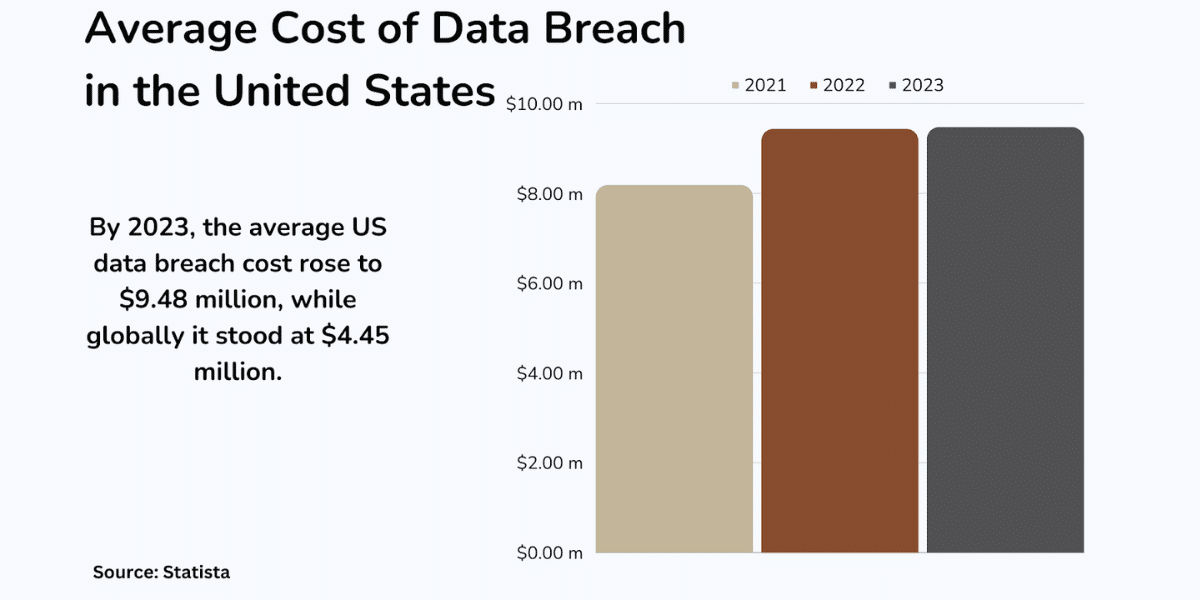
This indicates a growing financial impact of data breaches, emphasizing the urgent need for enhanced cybersecurity measures.
The Convergence of Threats and Exposure
Critical infrastructure security threats now emerge at an unprecedented pace. Attackers leverage AI cybersecurity innovations like machine learning for automation and speed. Meanwhile, critical infrastructure assets across sectors like energy, water, and transportation grow more technologically complex — expanding the attack surface. This leaves little room for traditional threat modeling approaches in infrastructure now bordering on intrinsic insecurity.
Modeling Threats Before Manifestation
Predictive threat modeling flips the script by forecasting risks ahead of time through:
- Extrapolation of threat trajectories based on early warnings
- Simulation of hypothetical attack scenarios and outcomes
- Machine learning for threat detection by analyzing patterns in historical incidents
This shift to proactive modeling enhances resilience by closing windows of exposure that reactive methods cannot.
The Evolution of Proactive Threat Assessment
Traditionally, critical infrastructure security has relied on reactive strategies, responding to attacks after the fact. But with cybersecurity predictive analytics and advanced threat modeling techniques, the paradigm now shifts towards proactively identifying and addressing vulnerabilities.
Maturing Technological Capabilities
Predictive analytics has vaulted forward in accuracy and viability through:
- Accumulation of big data sets tracking years of threats
- Maturing AI and ML capabilities
- Expanding real-time monitoring provides rich predictive fodder
- Cyber threat intelligence sharing expanding data diversity
These logarithmic technology improvements provide the foundation for predictive infrastructure threat mitigation across the interconnected landscape of essential services.
This shift has driven massive growth, with the global predictive analytics market size expected to reach $23.5 billion by 2025. Predictive modeling is essential to getting ahead of the curve as threats continue evolving.
A Strategic Approach to Predictive Threat Modeling
Implementing predictive threat modeling requires a holistic approach across people, processes, and technology. Key steps include:
Infrastructure Assessment
Thoroughly catalog infrastructure assets like hardware, software, networks, data stores, and third-party connections. Identify dependencies and flows between these components. Perform activities like network mapping to illustrate connections, while documenting existing security controls in place.
This foundational step clarifies the attack surface and most vulnerable points across the infrastructure. Asset inventories enable risk assessments on component criticality, likelihood of compromise, and potential impact.
Predictive Model Development
With infrastructure analysis complete, high-fidelity risk assessments can inform the design of tailored machine-learning models for threat detection. Models should simulate realistic attack scenarios and techniques from existing threat intelligence. For example:
- Power Grids: Models may simulate cascading failure scenarios by forecasting overload situations and infrastructure stresses.
- Transportation Systems: Models can ingest real-time operational data to predict anomalies and service disruptions from potential attacks.
- Water Treatment Facilities: Models can forecast contamination risks by learning from prior unsafe water incidents and attempted attacks.
Advanced modeling approaches like probabilistic threat analysis quantify the uncertainty around predictions. Models may also tap specialized data like Darknet forum monitoring to stay on top of emerging attack trends.
Integrating Predictive Analytics
To enable rapid, risk-aware response, predictive model outputs should directly feed into security operations workflows. Integration may involve:
- Using predictions for monitoring dashboards: Operators gain visibility into vulnerabilities and threats most likely to materialize.
- Generating actionable alerts: Infrastructure anomalies or specific attack forecasts should trigger alerts for operators to investigate.
- Informing automated countermeasures: For time-sensitive threats, predictive alerts can automatically trigger safeguards like system shutdowns or component isolation.
- Enhancing threat intelligence: Model-generated indicators should feed existing threat intel platforms, enhancing enterprise-wide alerting capabilities.
Two-way integration creates a positive feedback loop. Predictions empower security teams while human-led response activities continuously improve model outputs over time.
Safeguarding Mission-Critical Infrastructure Operations
While predictive threat modeling and cybersecurity predictive analytics focus on securing the technical footprint, the business context must also be considered. Critical infrastructure underpins essential, often life-sustaining services. Effective infrastructure threat mitigation requires aligning modeling with these mission-critical operational priorities.
Defining Mission Parameters
Categorizing infrastructure components by mission impact is crucial. This allows modeling to emphasize high-consequence elements like:
- Power: Assets enabling electricity generation and grid management
- Water: Facilities controlling treatment and distribution
- Transportation: Systems managing traffic monitoring, signaling, and control
Failures in these areas cause cascading impacts on dependent services. Aligning modeling to mission parameters ensures targeting where disruption matters most.
Simulating Operational Outcomes
With priorities mapped, simulations should model threat detection and outcomes tied to real-world impact. For instance, an airport attack prediction would outline:
- Degraded screening and checkpoints
- Flight delays and cancellations
- Economic ripple effects
Simulating functional degradation makes consequences tangible for leadership and informs mitigation plans.
Embedding Mission Focus
Every stage of predictive modeling should embed mission awareness, including:
- Monitoring: Trigger alerts for anomalies likely to disrupt critical processes
- Risk Assessments: Weigh the likelihood and impact of threats on essential functions
- Incident Response: Prioritize restoring mission-vital capabilities
This mission focus ensures modeling enhances resilience against threats targeting the availability and continuity of crucial societal lifelines.
Success Stories in the Public Sector
Predictive threat modeling is already bearing fruit across industries like energy and transportation. For example:
- The U.S. Department of Energy employs predictive systems to analyze threats and model impacts on the power grid.
- Singapore’s government developed the Internet of Things Intrusion Evaluation Framework (IoTIFY) – an automated predictive modeling toolkit securing critical IoT infrastructure.
- Atlanta’s Hartsfield Airport is exploring ways to leverage AI and machine learning to anticipate risks from insider threats, external attacks, and even pending natural disasters.
These examples highlight the expanding adoption of predictive strategies for national critical infrastructure security. The ability to preempt attacks before they occur is invaluable in limiting damage and service disruptions.
Adopting a Holistic Lens
By synergizing predictive capabilities with infrastructure’s underlying purpose, organizations take a 360-degree perspective. The human impact comes first, driving technology decisions. This ethos powers proactive modeling that fortifies both digital infrastructure and the vital services it provides.
Blending Predictive Technology with Human Expertise
While predictive analytics offers huge promise in shoring up defenses, human insight remains irreplaceable. When it comes to leveraging threat modeling outputs and fine-tuning systems, human expertise in cybersecurity plays a key role in two major areas:
- Interpreting and Contextualizing Predictions: Security teams add critical context in translating model outputs into action. Models may accurately signal anomalies but expert analysts determine the severity, priority, and required response.
- Refining and Retraining Models: Human feedback also allows for the continuous enhancement of the underpinning models powering predictive systems. As threats shift, analysts can retrain models by identifying new attack patterns.
Organizations that leverage both predictive technology and human talent gain an unmatched edge in securing critical infrastructure.
The Future of Predictive Threat Modeling
As modernization accelerates across critical infrastructure sectors, secure critical infrastructure is a top priority. Adoption of predictive threat modeling and cybersecurity predictive analytics will surge with the cybersecurity market expected to reach $345 billion globally by 2026.
Key technology drivers will include:
- Expanding real-time, cloud-based monitoring
- Commercialization of predictive cybersecurity solutions
- Maturing AI and machine learning capabilities
- Cross-industry collaboration on threat modeling
Meanwhile, threats will continue advancing via emerging attack vectors like deep fakes, quantum computing, and 6G networks. Amidst this complex, evolving landscape, predictive modeling is set to play a pivotal role in infrastructure threat mitigation.
Enhancing Infrastructure Resilience
Predictive threat modeling represents the new frontier of critical infrastructure protection. By anticipating risks, organizations can implement preventive safeguards, minimize fallout, and enhance resilience.
To embark on this cybersecurity journey, critical next steps include:
- Assessing infrastructure vulnerabilities
- Investing in monitoring and detection
- Building in-house predictive capabilities
- Exploring managed security options
The potential upside for securing essential services and limiting cascading failures makes adopting predictive practices a strategic imperative.
Conclusion
While modeling techniques will continue gaining sophistication, critical infrastructure must integrate predictive practices now to get ahead of looming threats in an increasingly perilous digital frontier. The window for proactive protection is narrowing.
Frequently Asked Questions
1. What is critical infrastructure security?
Critical infrastructure security focuses on protecting essential services like energy, water, transportation, and communications systems from cyber threats that could disrupt operations, cause safety risks, or enable terrorist attacks.
2. How does predictive modeling aid threat mitigation?
Predictive modeling leverages data patterns, simulations, and machine learning to identify vulnerabilities and anticipate cyber threats before they occur. This allows organizations to proactively deploy countermeasures.
3. What are some key components of a predictive cybersecurity architecture?
Critical components include real-time monitoring, predictive analytics engines, threat modeling, AI/ML capabilities, actionable alerting, and automated response mechanisms.
4. Why does human expertise remain crucial in advanced threat modeling?
While advanced AI and automation may drive predictions, human analysis is still indispensable in interpreting alerts, contextualizing risks, and steering the refinement of complex predictive systems.
5. What emerging technologies will shape future threat modeling innovations?
5G and 6G connectivity, IoT proliferation, cloud computing, quantum computing, augmented analytics, and edge computing are all poised to influence the next generation of predictive cybersecurity.
Published by: Nelly Chavez