By: Paul Fallin
We had the pleasure of speaking with architectural designer Qianhe Fan, whose work spans residential, commercial, and institutional contexts across Asia and the U.S. A graduate of The Cooper Union, Qianhe is currently developing the Cheonggyecheon Connectivity Pavilion in Seoul—a project that reflects his belief in restraint, precision, and architecture’s ability to quietly reshape public space.
Qianhe, tell us a bit about your path into architecture.
Qianhe: I studied at The Cooper Union after beginning at RISD. Since then, I’ve worked on urban developments, private commissions, and installations in China, Korea, and New York. What’s guided me throughout is a preoccupation with how architecture frames experience—not just formally, but structurally and culturally. The Cheonggyecheon Pavilion has been a focal point in that regard. It’s situated at the beginning of the Cheonggyecheon Stream, a dense urban corridor in the heart of Seoul, yet it doesn’t necessarily assert itself loudly. We’ve tried to design something that connects, redirects, and shelters—without overpowering its surroundings.
What drew you to that project specifically?
Qianhe: The pavilion emerged from an invited competition, where our team was selected as the winner out of five participating firms. It was a chance to work within a high-visibility public site with strict constraints and still explore architectural ideas. We were interested in modularity and lightness—not just visually, but logistically: how it gets fabricated, shipped, assembled, and eventually disassembled. That process is shaping the design as much as any formal decisions. The pavilion isn’t about leaving a permanent mark—it’s about staging a spatial pause in a city that rarely slows down.
Has working across regions affected how you approach a project like this?
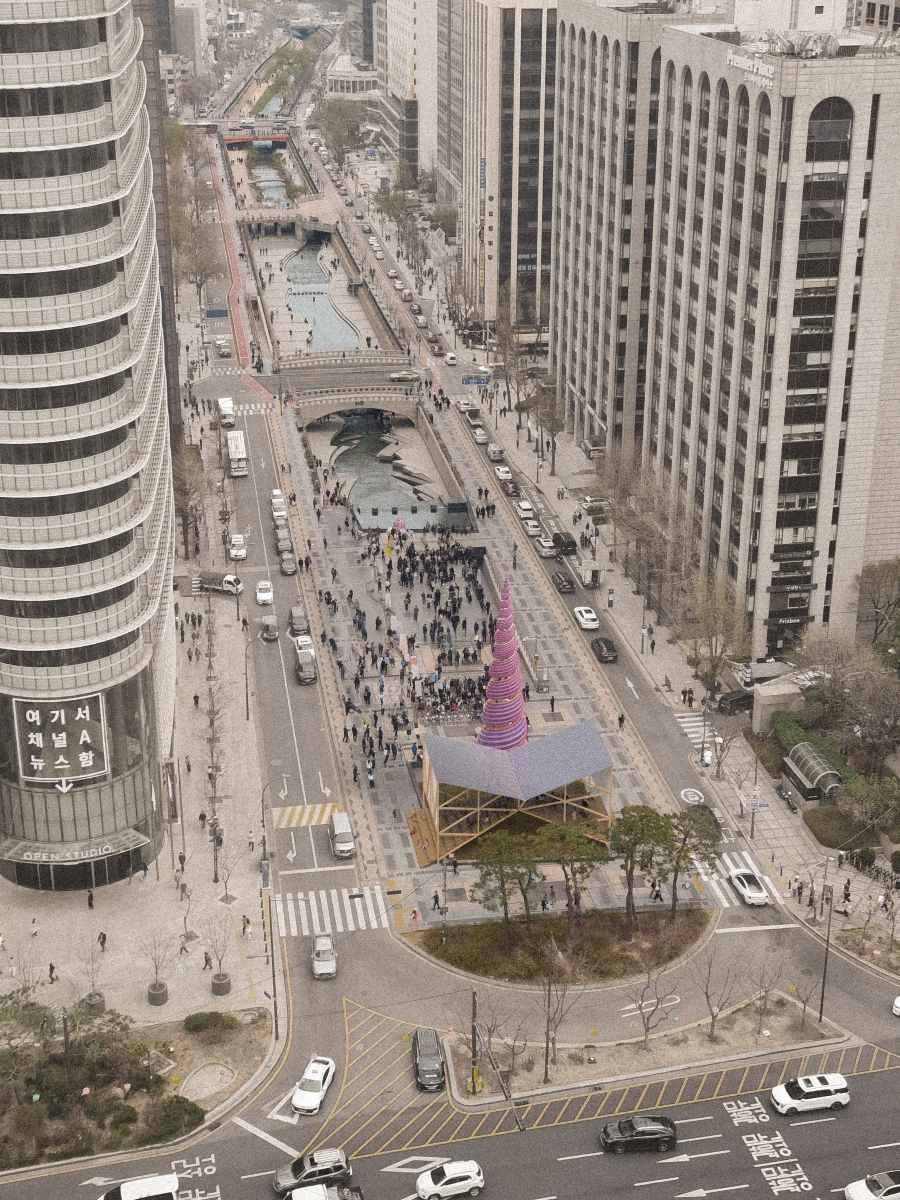
Qianhe: Definitely. Each region has its own institutional and spatial logic, which pushes you to recalibrate how you think about authorship, access, and intention. The resolution for such differences is an important anchor for my design. Seoul has a very active public competition culture that allows for a level of conceptual ambition—but you still have to make something legible to its unique audiences, while meeting the budget. Compared to my work in New York, where communal policies and compliance are often front and center, this project let us focus on elemental relationships: form, articulation, and openness. That contrast has been useful in clarifying my design approach.
What are some challenges you’ve faced in the design process?
Qianhe: We’re currently developing the structural details, and logistics has become a central design problem. It’s a temporary structure, so every decision—from member sizing to connection type—has to support ease of assembly and disassembly. The assembly will happen abroad, so it needs to pack efficiently while still supporting architectural intent. That’s where design meets choreography. It’s not just a question of how it looks, but how it moves through space and time.
What has this project taught you about your own design values?
Qianhe: That withholding can often be more powerful than declaring. The pavilion doesn’t seek to monumentalize—it’s an open structure meant to fold into the rhythms of urban life. I’m drawn to that kind of architecture: precise yet quiet, grounded yet open-ended. The discipline already has enough spectacle. What we need more of are projects that reward attention, that sharpen perception rather than overloading it.
We designed the project with flexibility in mind—so that its core intent could carry through while remaining open to input from engineers. Collaborating with TYLin (formerly Silman) has helped reinforce for me how structural design can sharpen rather than dilute an architectural idea. The clarity of the concept allowed for meaningful back-and-forth, where engineering constraints became opportunities for refinement.
For me, architecture isn’t about expression so much as framing relationships—between people, materials, and the ground they occupy. What matters is whether a project continues to pose questions—of the site, the public, and myself. That’s the work I want to keep doing.