In the fast-paced, competitive environment of New York City, businesses are continually seeking ways to innovate and grow. One critical component that has increasingly become a cornerstone of business strategy is the software contract. These agreements, which outline the terms of use, support, and maintenance for software products, have evolved significantly over the years and now play a pivotal role in helping businesses succeed.
The Evolution of Software Contracts
Software contracts have come a long way since the early days of the technology industry. Initially, software agreements were relatively simple, focusing mainly on licensing terms and basic support. However, as software has become more integral to business operations, these contracts have grown in complexity and importance.
In the past, software contracts were often viewed as a formality, a necessary but unexciting part of doing business. Today, they are seen as strategic tools that can offer competitive advantages. Modern software contracts now include detailed clauses on service levels, data security, compliance with regulations, and more. This shift reflects the growing recognition of software as a critical business asset rather than just a tool.
Key Changes in Software Contracts Over the Years
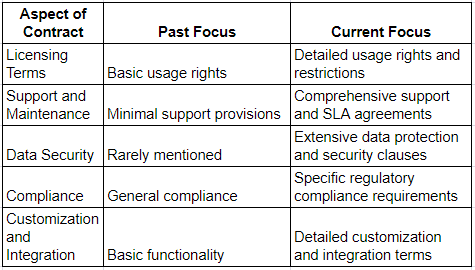
This table illustrates how various aspects of software contracts have evolved, highlighting their increasing complexity and strategic importance.
Enhancing Business Operations
For businesses in New York, software contracts are not just about acquiring tools; they are about enhancing operations and ensuring continuity. These contracts provide a clear framework for how software will be used, supported, and evolved over time, which is crucial for maintaining smooth business operations.
Effective software contracts ensure that businesses have access to the necessary tools and support when they need it. This reliability is particularly important in a city like New York, where downtime can translate into significant financial losses. By clearly defining service levels and support expectations, these contracts help businesses avoid disruptions and maintain productivity.
Additionally, software contracts often include provisions for regular updates and upgrades, ensuring that businesses can keep pace with technological advancements. This ongoing access to the latest features and improvements helps businesses stay competitive and responsive to market changes.

Driving Innovation and Growth
Beyond maintaining operations, software contracts are also instrumental in driving innovation and growth. By securing access to cutting-edge software solutions, businesses can explore new ways to enhance their products and services, streamline processes, and improve customer experiences.
For instance, many software contracts now include clauses that allow for customization and integration with other systems. This flexibility enables businesses to tailor software solutions to their specific needs and seamlessly integrate them into their existing workflows. As a result, businesses can develop more efficient processes and create more value for their customers.
Furthermore, software contracts often come with detailed training and support provisions, ensuring that employees can effectively use new tools and technologies. This support is essential for maximizing the return on investment in software and fostering a culture of continuous improvement and innovation.
Success Stories from New York
Several New York-based businesses have leveraged software contracts to achieve remarkable success. For example, a financial services firm used comprehensive software agreements to secure robust data analytics tools, which allowed them to gain deeper insights into market trends and client behavior. This capability enabled the firm to offer more personalized services and significantly increase client satisfaction and retention.
Similarly, a healthcare provider in New York City utilized software contracts to implement a state-of-the-art patient management system. The detailed support and training provisions in the contract ensured a smooth transition to the new system, leading to improved patient care and operational efficiency.
These case studies underscore the transformative potential of well-negotiated software contracts. By providing access to advanced tools and ensuring effective implementation, these contracts can help businesses unlock new opportunities for growth and success.
Conclusion
Software contracts have become indispensable for businesses in New York, providing a foundation for reliable operations, driving innovation, and fostering growth. As these contracts have evolved, they have become more comprehensive and strategic, reflecting the critical role of software in modern business. By carefully negotiating and managing software contracts, businesses can secure the tools and support they need to thrive in the competitive landscape of New York City.
Published By: Aize Perez