Revenue-based financing, often shortened to RBF, gives a company capital today in exchange for a percentage of its future revenue until a set amount has been repaid. You don’t give up ownership, and payments generally rise and fall with sales. Depending on the provider and the amount, funding can take as little as a day or as long as a few weeks.
Providers tend to describe this product in glowing language. Each section below sets a common sales claim next to what the contract may actually say, so that you can read both sides before you make a decision.
The Pitch: “It’s Non-Dilutive Capital”
What that means: Unlike selling stock, RBF leaves your cap table untouched. A founder who owns 100% of a business before the deal still owns 100% after it.
What the fine print may add: Most deals don’t require equity, but some investor-led structures include warrants or a conversion feature. Look for those words before assuming nothing is being given up. And non-dilutive doesn’t mean free. If you’d be repaying 1.4 times the money received, you’re giving up a share of cash instead of a share of ownership.
The trade-off generally favors RBF when a business is profitable or close to it, and when the owner believes the company’s future value justifies keeping all of its equity. Companies losing heavily and growing at venture rates may be better served elsewhere. A general product summary like Fundivi revenue-share funding can help you learn how the terms are presented to borrowers.
The Pitch: “Your Payments Flex With Your Sales”
What that means: With a pure percentage structure, a slower month brings a smaller payment.
What the fine print may add: Many products marketed this way use fixed daily or weekly debits based on estimated revenue, then reconcile periodically. Others set a minimum payment or a maximum repayment date. The practical differences are large:
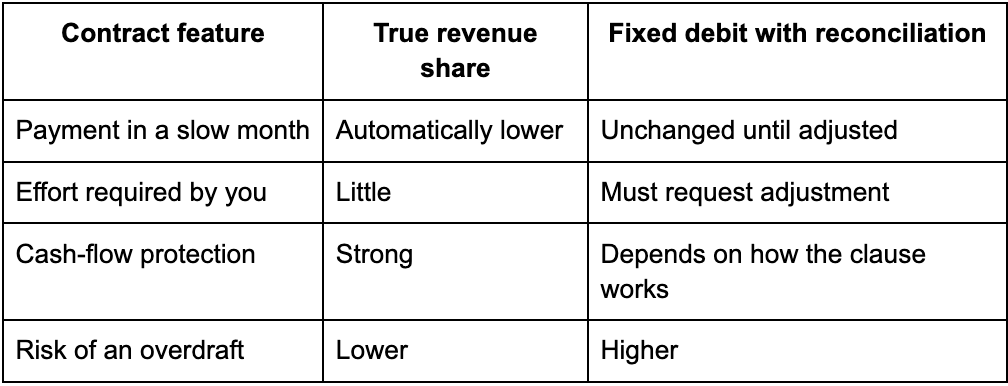
Ask to see how payment would be calculated in a month when revenue falls by 40%. If the answer is vague, assume the flexibility is limited.
The Pitch: “No Interest Rate, Just One Simple Fee”
What that means: Pricing is usually a cap, multiple, or factor. A $100,000 advance with a 1.25 cap means $125,000 in total payments.
What the fine print may add: The simplicity conceals an annualized cost that depends entirely on how quickly you repay. Here is that same deal at three speeds:
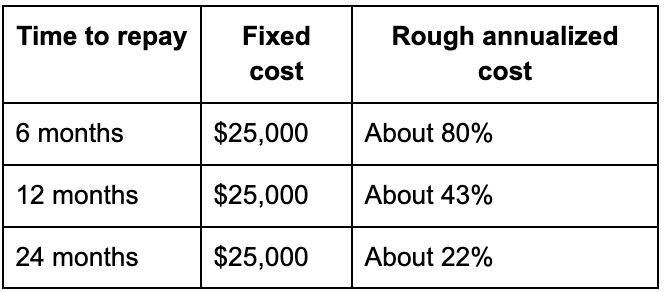
These are approximations that assume steady payments. They illustrate the odd feature of this product: the better your business performs, the more quickly you repay and the higher your annualized cost becomes. The dollar total, however, doesn’t change. Determine which of those two measures matters more for your decision. A company using the funds on a high-margin campaign might not care about the annualized figure, whereas one comparing the deal to a bank loan certainly should.
Lender roundups such as this overview of small business loan companies in 2026 can help you see what else is on the market, though each one deserves the same skeptical reading.
The Pitch: “Funding in 24 Hours”
What that means: Automated review of bank or platform data can produce a very quick decision.
What the fine print may add: Speed depends on several conditions.
Fast outcomes generally require:
- Revenue that can be verified automatically from bank or platform connections
- A reasonable request relative to monthly revenue
- Complete ownership and identification records
- No conflicting liens or undisclosed advances
- An application made early on a business day
Slow outcomes tend to involve larger investment-style deals, in which a provider reviews detailed subscription metrics such as churn, net revenue retention, and customer acquisition cost. Those transactions can take weeks.
Note that read-only connections require careful handling. Find out what data the provider will see, how long it can access your accounts, and how to disconnect after the balance is paid. Some contracts require you to keep those connections active, and a dropped connection may even count as a default.
The Pitch: “Credit Score Doesn’t Matter”
What that means: Revenue patterns often carry more weight than a personal credit score.
What the fine print may add: Many providers still review credit, liens, judgments, tax debts, and prior defaults. A personal guarantee could still be required, or a guarantee covering specific behavior such as fraud or diversion of revenue. Read that section, even if the salesperson says that it’s not a personal obligation.
Other developments in this part of the market can help you compare options. For instance, this Fundivi press release on term loans and SBA figures, carried on Business Insider Markets, gives context on the fixed-payment alternative and on how much government-backed lending took place in the latest fiscal year.
The Pitch: “It’s Perfect for Growth”
What that means: RBF can fund inventory, advertising, and other spending with fast, measurable payback.
What the fine print may add: The revenue share comes off the top. Run this test before accepting that it’s perfect for you.
Margin test: A business with $100,000 in monthly revenue, 40% gross margin, and $30,000 in fixed costs earns $10,000 per month. A 7% revenue share takes $7,000 of that $10,000. Unless the funded project raises profit by a meaningful amount, the owner has only $3,000 left over and very little room for error.
RBF generally fits businesses with these characteristics:
- High gross margins, often found in software and some consumer brands
- Predictable, recurring revenue
- A clear use of funds with measurable returns
- Owners who want to avoid giving up equity
It’s generally a poor match for low-margin resellers, seasonal companies with long dead periods, and businesses already struggling with existing debt.
The Pitch: “We’re Rated the Best”
What that means: Ratings sites can help you find providers.
What the fine print may add: Some sites are paid for their placements, so ask how the list was created. Comparison hubs that earn referral fees, such as the BestWorkingCapitalLoans.com provider directory, can offer a helpful start, but you should verify any company’s contract, licensing, and complaints yourself.
Five Contract Definitions to Inspect
The following words have outsized effects on what you’ll pay:
- Revenue: Is it gross deposits or net sales after refunds and taxes?
- Cap: Is the total fixed, or can it increase if you repay slowly?
- Reconciliation: How often, and at whose request?
- Change of control: What’s owed if you sell the company?
- Additional indebtedness: May you take on other financing during the term?
A difference in the first definition alone can be substantial. If 15% of your deposits are pass-through amounts like sales tax or reimbursements, a share of gross deposits effectively costs you more than a share of net revenue at the same percentage.
The Bottom Line
RBF is neither a miracle nor a trap. It’s a tool that trades a share of future sales for present cash. When your margins can absorb the share and the money has a measurable return, it can be efficient and fast. When the same share eats up your profit, no amount of flexibility will save the deal.
Frequently Asked Questions
How much can a business raise through RBF?
Amounts are often tied to monthly or annual revenue, sometimes a multiple of monthly recurring revenue for subscription companies.
How long does repayment take?
Commonly from several months to a few years, depending on your revenue, share percentage, and cap.
Is RBF the same as a merchant cash advance?
They’re related, but not identical. MCAs are usually shorter-term and purchase receivables, while RBF deals can be longer-term and tailored to growth companies.
Can I repay early?
Often, but the full cap might still apply. Ask about any discount for early payoff.
Will RBF help my credit?
It usually won’t appear on personal credit reports. Ask whether the provider reports to business credit bureaus.
What documents do I need?
Typically, bank statements, revenue reports, ownership details, and identification. Investor-style deals may also need detailed financial metrics.
Do startups qualify?
Most providers need consistent revenue for several months. Pre-revenue startups generally won’t qualify.
Who is RBF best for?
Generally, companies with high margins and predictable recurring income.
Disclaimer: This article is for informational purposes only and does not constitute financial or legal advice. Financing terms, eligibility, costs, and repayment structures vary by provider. Funding within 24 hours is not guaranteed. Business owners should carefully review all agreements and consult a qualified financial professional before making financing decisions.