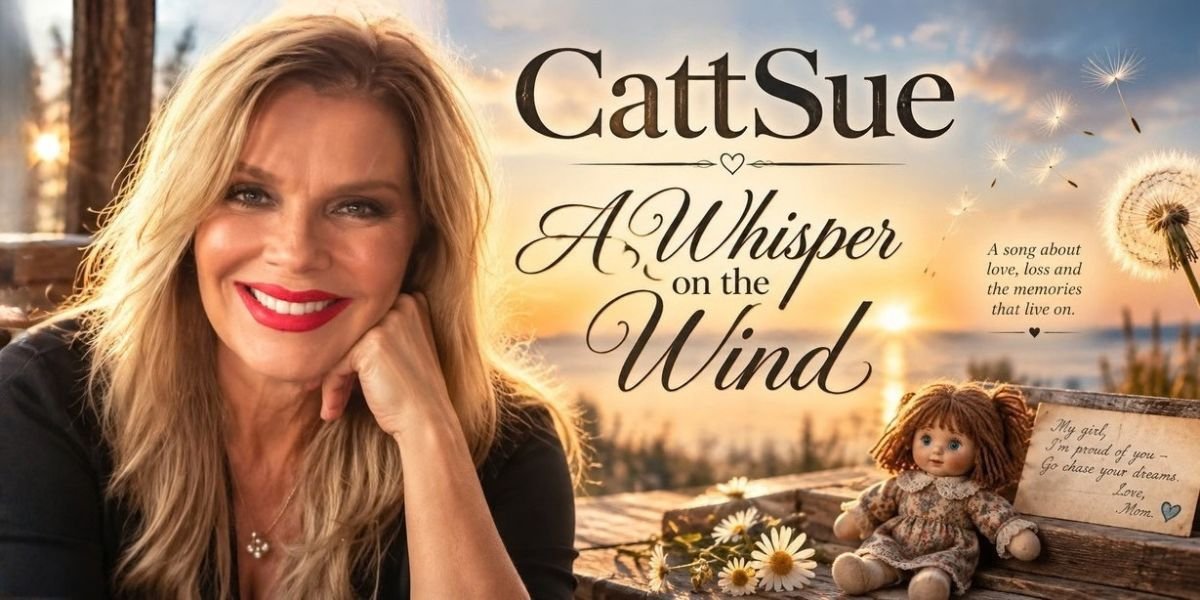
By: Rachel Donovan
For CattSue, becoming a recording artist wasn’t so much about discovering a new ambition as finally giving herself permission to pursue one that had been waiting for her.
The independent singer-songwriter says one of the defining moments of her career came when she stopped treating music as something that needed to remain tucked away. The release of “Come Home to Me” confirmed that intensely personal songwriting could connect with people beyond her immediate world, and that realization changed how she viewed both her music and herself.
“I don’t have to become somebody else to have a place in this business,” she says. “I can tell my stories in my voice, at this point in my life, and there is an audience for them.”
That philosophy reaches its most personal expression yet with “A Whisper on the Wind,” a song born from losing her mother when CattSue was just four and a half years old.
The loss has been with her nearly her entire life, but CattSue says she couldn’t have written the song years ago. Understanding grief at four is profoundly different from understanding it as an adult.
“As a little girl, I understood that Mommy was gone,” she explains. “As an adult woman, I began understanding everything that meant.”
Eventually, those two perspectives, the grieving child and the woman she became, could coexist within the same song.
“‘A Whisper on the Wind’ wasn’t written because the grief suddenly appeared,” she says. “It was written because I was finally ready to give that grief a voice.”
One of the song’s most powerful details is remarkably ordinary: a Mrs. Beasley doll.
Following her mother’s death, the doll became something young CattSue could physically hold during an experience she couldn’t possibly comprehend. Decades later, Mrs. Beasley became a symbol of childhood grief and the way seemingly insignificant objects can absorb enormous emotional meaning.
“I think everyone has their own version of Mrs. Beasley,” CattSue says. “Maybe it’s a photograph, a piece of clothing, a song, a recipe, something tucked away in a drawer. Sometimes an ordinary object ends up carrying an extraordinary amount of love.”
Perhaps more difficult than writing about what she remembers was confronting what she doesn’t.
CattSue cannot completely retrieve some details of her mother, including the sound of her voice. Rather than inventing memories to complete the narrative, she made those missing pieces part of it.
“Sometimes absence is part of the memory,” she says.
That idea gives the song’s title another dimension. A whisper on the wind becomes something sensed rather than possessed, a connection that remains even when specific memories have faded.
Musically, CattSue is equally unwilling to manufacture an identity simply because the industry prefers convenient categories. Her work moves among country, Americana, pop, and the broader singer-songwriter tradition. Country remains foundational because of its emphasis on storytelling, but she increasingly allows each composition to dictate its own sound.
“The thread connecting everything is emotional honesty and storytelling,” she says.
It is a philosophy that also influences how she navigates an independent music industry dominated by streaming platforms, social media, and constant demands for new content.
CattSue recognizes their importance. She simply refuses to confuse the machinery used to distribute music with the reason for making it.
“I remind myself constantly which one is the tool and which one is the art,” she says.
Rather than beginning with the question of what might produce fifteen seconds of effective social content, she begins somewhere considerably less calculated: “What do I need to say?”
Only after answering that question does promotion enter the equation.
Her perspective has been shaped by two places. CattSue grew up in West Deptford, New Jersey, where many of the experiences that eventually became songwriting material began: childhood, family, friendships, first loves and loss.
“There’s probably a little bit of that Jersey toughness in me too,” she says. “You learn to get back up.”
Jacksonville represents a different chapter, the place where much of her adult professional and personal life developed and where her current musical journey began taking shape.
“Maybe New Jersey gave me a lot of the stories, and Jacksonville gave me the space and courage to start telling them.”
Those stories are increasingly becoming less exclusively hers.
That is particularly true of “A Whisper on the Wind.” Although written from an experience unique to CattSue, she hopes listeners will recognize their own mothers, fathers, spouses, children, friends, and loved ones within it.
Her message isn’t that grief eventually vanishes. It’s that grief and living can occupy the same heart.
“Grief changes,” she says. “It moves around. Sometimes it whispers, and sometimes it walks right through the front door without knocking.”
Continuing to remember someone, she believes, doesn’t mean refusing to move forward. A person can laugh, love again, build a life, chase dreams, and still experience moments when they would give almost anything to hear a lost loved one’s voice.
For CattSue, that isn’t a failure to heal.
“That’s love continuing in a different form.”
It may also explain why “A Whisper on the Wind” represents such an important moment in her career. CattSue isn’t merely finding an audience. She’s discovering exactly what she wants to say to it.
And if somebody spends four minutes with her song and recognizes their own grief within hers, that’s enough.
“The song,” she says, “has done exactly what I wanted it to do.”