By: Robert Mitchell
Rock and roll was never supposed to be polite. It was supposed to challenge authority, question assumptions, and remind ordinary people that their lives mattered. Somewhere along the way, much of that revolutionary spirit became another product to package and sell. And somewhere else, contemporary Christian music developed its own formulas, complete with predictable choruses, calculated emotional crescendos, and a tendency to confuse volume with conviction.
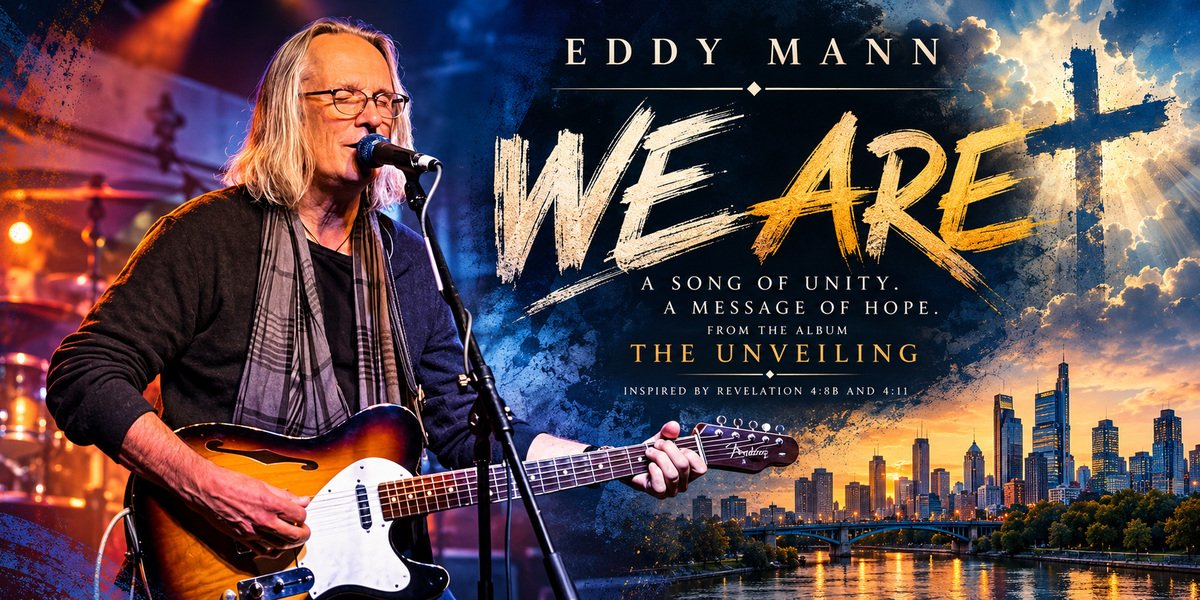
Then along comes Eddy Mann, a veteran Philadelphia-area songwriter and minister, now living in Florida, with “We Are,” a jazz-influenced worship song written in 5/4 time and inspired by the Book of Revelation.
There’s nothing particularly rebellious about that description.
Until you listen to what he’s saying.
“We are Your will / We are Your desire / We are Your pleasure.”
Those words contain a challenge that extends considerably beyond the walls of any church. In a society increasingly organized around competition, alienation, and the relentless celebration of individual success, Mann makes a declaration of collective identity.
Not I am.
We are.
That distinction matters.
Popular music has always been at its strongest when it recognizes the connection between individual experience and collective struggle. Gospel understood it before rock and roll existed. The blues gave personal suffering a communal language. Soul music transformed private longing into public testimony. The best protest songs reminded listeners that isolation could be overcome through solidarity.
Mann’s “We Are” belongs, spiritually if not stylistically, to that tradition.
The song comes from The Unveiling, Mann’s ambitious album inspired entirely by Revelation. That biblical text has supplied generations of musicians with images of destruction, judgment, and impending catastrophe. Heavy metal has made an entire visual vocabulary out of its nightmares.
Mann finds something else.
He finds a reason to believe humanity might still have a future worth sharing.
Inspired by Revelation 4:8b and 4:11, “We Are” begins with the familiar declaration, “Holy, holy, holy.” But rather than constructing another oversized worship anthem, Mann moves toward something more reflective and musically adventurous.
The song unfolds in 5/4 time.
Mann says he didn’t deliberately choose the unusual meter. It emerged naturally during a quiet devotional moment, as though the composition had discovered its own internal logic.
That’s a significant detail because the rhythm never feels like a musician showing off.
Instead, the extra beat creates a sense of movement that resists the comfortable predictability of conventional worship music. The song refuses to march where the listener expects it to march.
There’s a lesson in that refusal.
Faith shouldn’t require intellectual or artistic obedience to formulas. Neither should music.
The jazz influence gives “We Are” a vocabulary of freedom, allowing the song to breathe rather than pushing it toward some predetermined emotional climax. Where much contemporary worship relies upon repetition to produce overwhelming intensity, Mann uses repetition to encourage reflection.
His vocal approach follows the same philosophy.
After more than three decades of music and ministry, Mann doesn’t need to manufacture urgency. His delivery suggests the confidence of someone who has spent years considering the questions behind the words.
He isn’t trying to win an argument.
He’s bearing witness.
And what he’s witnessing is something our culture desperately needs to hear.
Mann has spoken about his commitment to brotherhood and sisterhood, observing that divisive rhetoric continually nourishes separation. He’s right about the mechanism. Division doesn’t sustain itself. It requires constant reinforcement, an endless supply of suspicion, resentment, and manufactured enemies.
Music can participate in that machinery, or it can challenge it.
“We Are” chooses the latter.
That doesn’t mean the song is politically specific. Mann doesn’t identify parties, politicians, or institutions. His argument begins with theology rather than public policy.
But the social implications remain.
If humanity possesses shared purpose and dignity, then the categories we construct to separate ourselves deserve scrutiny. Religious identity becomes an invitation to responsibility rather than an excuse for exclusion.
It’s an ambitious idea for a song built around such economical lyrics.
And Mann deserves credit for trusting his listeners to recognize its implications without spelling out every conclusion.
The broader context of The Unveiling reinforces that approach. On “I Will Never Know the Desert Again,” Mann considers Revelation’s promise of an end to suffering, transforming biblical imagery into a statement of hope for people experiencing physical, emotional, and spiritual hardship.
“We Are” takes the next step.
Hope isn’t merely something individuals possess.
It’s something people create and sustain together.
Of course, there are limitations to Mann’s approach. His optimism can feel almost too gentle for the brutality of the world he addresses. Brotherhood is easier to celebrate than to practice. Unity becomes meaningless when it asks the powerless to overlook injustice or treats legitimate disagreement as a failure of compassion.
A song about togetherness must ultimately confront those contradictions.
“We Are” doesn’t fully explore them.
But perhaps that’s asking this particular composition to carry more weight than its devotional purpose allows. Mann isn’t writing a manifesto. He’s offering a starting point, a reminder that community must exist before meaningful collective action becomes possible.
And that brings us back to the music.
The most persuasive quality of “We Are” isn’t its theology alone, or even its unusual rhythmic structure. It’s the relationship between the two.
The song advocates unity while refusing musical conformity.
That’s an important distinction.
The best communities don’t eliminate individuality. They make room for it. Jazz has demonstrated that principle for generations: independent voices listening, responding, challenging, and ultimately creating something larger than themselves.
Mann’s five-beat worship meditation reflects that same possibility.
By the final declaration of God’s worthiness, the song has made its argument without raising its voice.
There are no fireworks.
No apocalyptic threats.
No demand that the listener surrender independent thought.
Just an experienced songwriter, an unconventional rhythm, and an ancient idea that remains stubbornly relevant.
In a music business obsessed with individual brands and a culture increasingly addicted to division, Eddy Mann has released a song that insists the most important pronoun might still be plural.
That’s not a revolution by itself.
But revolutions have begun with less.
“We Are” reminds us that before people can change the world together, they have to remember that they belong to one another.
And that’s a message worth singing, whether the song has four beats, five beats, or no beat at all.
Tighten the opening’s broad claimsAdd more concrete musical description