By: Kate Sarmiento
Harry Chemko started his first company with a $15,000 loan and a gap he spotted in the market (Source: BDC and Elastic Path, 2008). He has spent 25 years building commerce technology, and he is now co-founder and CEO of ShopVision, a market intelligence platform. ShopVision goes after a second gap, the one between what a company knows about itself and what it knows about its competitors.
Brands and retailers know their own sales, traffic, and margins in fine detail. Competitors’ prices, promotions, ads, and product launches are harder to see, and many teams piece that picture together with spreadsheets, manual searches, delayed reports, and judgment. That can work with a few products and a few competitors, and it gets harder as both lists grow.
According to ShopVision, Chemko spent about two decades watching brands and retailers need a clearer view of their market before he built one. His earlier company is a good place to start.
The Store Knows Its Shoppers and Nothing About the Store Down the Street
That company was Elastic Path, which Chemko co-founded in 2000, after graduating. He and his partners began as a small consulting firm that built online applications for companies. After several e-commerce projects, they saw that nothing served the space between very expensive enterprise vendors and small-business shopping carts, so they turned their work into a product for that space (Source: BDC and Elastic Path, 2008).
That product became software that powered the online sites of large brands, including Garmin, Samsonite, and Aeroplan. By 2008 the company served more than 180 customers worldwide, and it handled the retailer role for the online store of the Vancouver 2010 Olympic and Paralympic Winter Games (Source: BDC and Elastic Path, 2008).
An online store records a great deal about its own shoppers, from what they view to what they buy. It records nothing about what competitors are doing at the same moment. ShopVision, founded in 2024, was built around that blind spot.
One reason the blind spot has lasted is that information about competitors is scattered and inconsistent. It sits on other companies’ websites, in their email and text campaigns, and in their ads, and none of it is formatted for anyone else’s use. Even a basic price comparison depends on knowing whether two listings describe the same product, and products do not always share a code from one retailer to the next.
Matching a Sneaker to Its Twin Takes More Than a Web Scraper
ShopVision addresses the matching problem with LLM-based web agents, which are AI programs built on large language models. They read competitor and reseller websites in a way that resembles how a person reads a site, which gives them more contextual interpretation than traditional code-dependent scraping. That is what allows the platform to pair equivalent products that have no shared identifying code.
Each proposed match comes with a confidence score and the reasoning behind it. Teams can approve or reject a match, and that feedback goes back into the system. A price comparison built on a wrong match can send a team in the wrong direction, so the score and the reasoning give a person something to check before acting.
Behind the matching sits a dataset that covers more than 300,000 brands, retailers, and marketplaces and tracks 15 million products a day. ShopVision calls it the deepest dataset in commerce, which is the company’s own claim. Its stated goal goes past collection, to telling teams what changed in the market, what is happening now, and what to do next. ShopVision describes older tools as ones that hand customers a data file and leave the analysis to them.
A recent bankruptcy filing has put this part of the software industry in the news. Wiser Solutions, a software company that collects data from retailers, filed for Chapter 11 protection in Texas in late April 2026 with about $563 million in debt and a plan to sell its business to its main lender (Source: Law360, 2026). One filing does not explain an industry, and the reasons behind it belong to that company. It does raise a fair question about what competitive data is worth to a team once it has been collected.
Start With a Free Trial, Then Add Products as the Questions Get Bigger
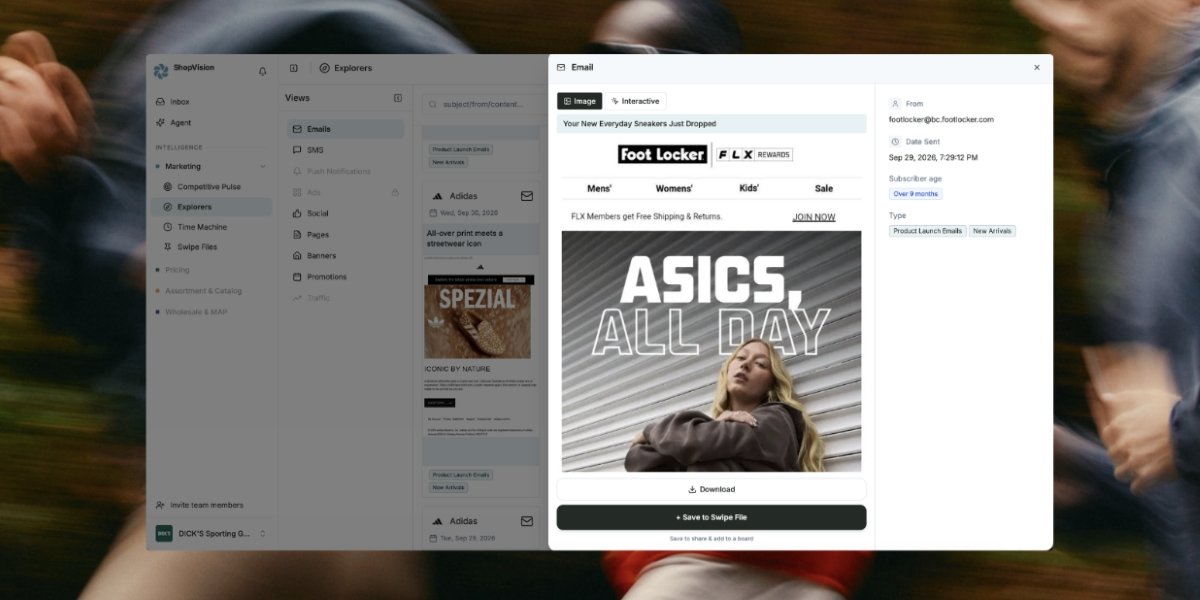
ShopVision sells four products that can each be bought on their own. Marketing Intelligence shows competitor ads, promotions, emails, and campaigns as they go live, along with an action plan. Pricing Intelligence tracks competitor prices and refreshes them daily. Assortment and Catalog Intelligence follows what competitors and the wider category launch, discontinue, and restock. Wholesale and MAP Intelligence watches resellers for violations of minimum advertised price, the lowest price a reseller is allowed to advertise, and records screenshot and timestamp evidence.
All four run on the same dataset and matching layer, so what is collected for one can strengthen the market view in the others. Marketing Intelligence is the self-serve entry point, and its Starter plan includes a 7-day free trial. The other three products are sold through sales.
More software is also being built to act on its own. Gartner forecast in 2025 that 40 percent of enterprise applications would include task-specific AI agents by the end of 2026, up from less than 5 percent at the time (Source: Gartner, 2025). That is a forecast, so it describes where things are headed, and the year is not over. An AI agent that sets prices or plans promotions using only internal data has the same blind spot as a team working from internal reports alone.
ShopVision offers an MCP connector, a standard way for AI tools to link to outside data, so that approved AI tools and agents can reach the same market intelligence its human customers use.
Human judgment still matters. A Gartner research abstract published in September 2026 says full autonomy in retail is years away and that technology providers will win by offering a trusted layer for coordinating decisions (Source: Gartner, 2026). Confidence scores and visible reasoning give teams a way to check the work before acting on it.
Before Peak Season, Find Out What Your Team Can Actually See
Chemko’s career has moved from building the systems brands use to sell online to building one that shows what the rest of the market is doing while they sell. A company with a clear view of its own numbers and a blurry view of its competitors is making some of its biggest decisions with half the picture. ShopVision’s view is that Black Friday is decided in hours, not days, which makes the weeks before it the time to close that gap.
A practical first step is to list the last few pricing, promotion, or assortment decisions the team made and mark which ones relied on current competitor data. Teams that find gaps can look at ShopVision’s Market and Competitive Intelligence platform, start with the Marketing Intelligence free trial, and check the public pricing to see what fits.