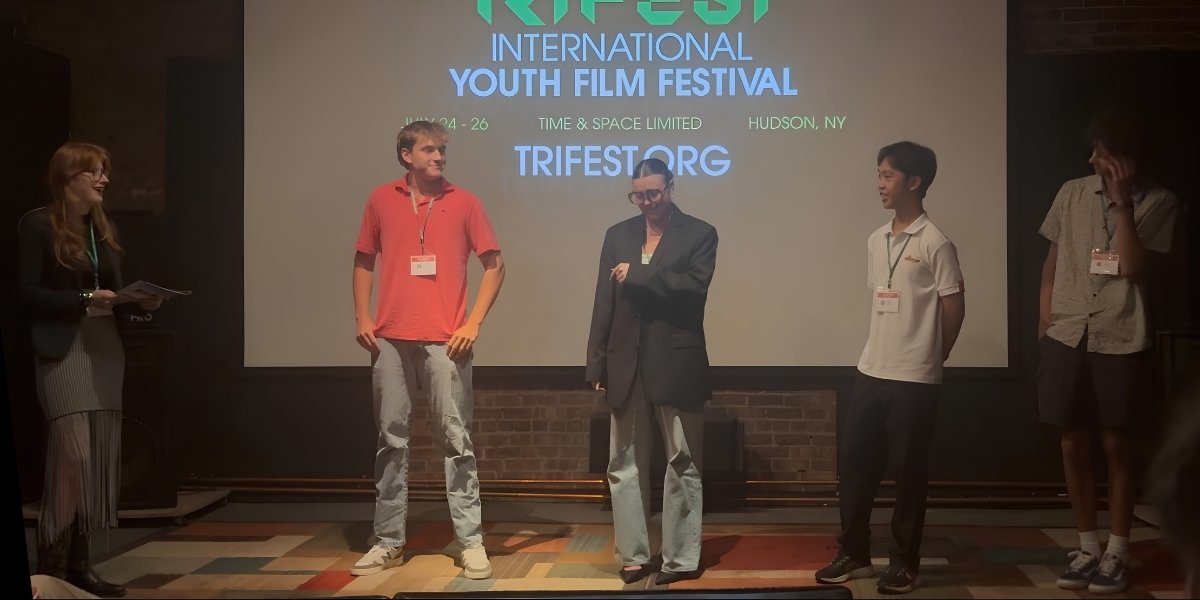
On a Saturday afternoon in late July, at an arts venue called Time and Space Limited in Hudson, New York, Ivan Zhuo sat among strangers and watched his own film play for its first festival audience. Zhuo is 17, from Oakville, Ontario, and Seeds of a Scarred Land is his directorial debut: a short documentary, just under 18 minutes, in which four young Bosnians and one war veteran reflect on what it means to inherit a war that ended before they were born. The film screened as part of the Official Selection of the TRIFEST International Youth Film Festival, whose documentary jury this year included Emmy Award winner Tony Gerber and two-time Pulitzer Prize laureate Lynn Nottage.
In the days before the festival, Zhuo was not sure what he was walking into. It was his first in-person film festival. Hudson is a small river town about two hours north of Manhattan, and he wondered aloud whether people would travel for a Saturday-afternoon documentary at all. His hope was that an American audience would meet the film on its humanitarian terms, as a portrait of a country moving beyond its past rather than another story about a war zone. His nervousness centered on the Q&A. As an outsider telling another country’s story, he wanted to speak about Bosnia with accuracy and care, and he knew the conversation after the credits would test that as much as the film itself.
Before leaving for New York, he shared the news of the selection with Sofija Blagojevic, the participant who had helped him build his network of interviewees in Bosnia. Her role in the film’s existence would come up again sooner than he expected.
The Questions He Did Not Expect
The moderated Q&A opened with a familiar question: what inspired the film. Zhuo’s answer went to the gap he believes the film fills. “Mainstream media doesn’t show you a lot of how people are affected after a war,” he told the room, describing coverage that follows conflicts while they happen and falls quiet once they end. The generation that grows up afterward, he argued, is a blind spot, and for audiences living in peace it offers a better perspective on how to read the news of other wars.
The harder questions came from the audience. One arrived from a film student whose own narrative short screened that evening: how did Zhuo find his interview subjects in a country where he knew no one? He traced the chain out loud. A teacher he knew had once taught at an international school in Bosnia. Through that connection he reached a student entering her senior year there, and through her, a widening web of friends of friends, until he found Sofija, who helped him reach the others. The subject remains taboo enough in the country, he explained, that finding people willing to speak on camera was one of the production’s hardest problems. That the question came from a filmmaker with far more formal training than his own gave him, he says, a quiet sense of pride that the documentary exists at all.
The question he had not prepared for came from an audience member who had visited Bosnia only a month earlier and recognized Yugoslav-era monuments in the film’s footage that he had seen in Mostar. He asked how the young people Zhuo met relate to the memory of Yugoslavia. The film does not focus on that period, and Zhuo had to answer from experience rather than script. He described a generational divide: older Bosnians who lived through the Yugoslav era often speak of it with real nostalgia, while the generation born decades after its peak feels largely disconnected from it and rarely wants to discuss it. He anchored the point in an anecdote from his own school in Canada, where a teacher from North Macedonia still shows students the medals from his mandatory service in the Yugoslav army.
What Eighteen Minutes Can and Cannot Do
The conversations that followed the screening taught Zhuo as much as the Q&A did. The festival’s administrative director, who studies sociology and film in college, had made a point of watching the documentary. A festival staff member who saw it wanted to understand more about the country’s structure, and Zhuo found himself explaining Bosnia’s three ethnic communities and two political entities in person, even though the film opens with a short visual explainer covering exactly that. The exchange crystallized a limitation he had suspected: no 18-minute film can carry the full complexity of Bosnia’s history and political reality to someone encountering it for the first time.
It further clarified what the film is actually for. Explaining Bosnia’s past and present, he reflects, is work a textbook or an encyclopedia page can do. What the film does instead is make the subject human, presenting post-war Bosnia through youth testimony and individual stories, which he now believes moves people in a way words on a page rarely do. The screening also changed how he understood his own presence in the film. The documentary follows him, an outsider, as he learns about his interviewees and the cities he visits, and he realizes in Hudson that this structure does quiet work: the narrator travels with the same perspective the audience holds, which makes the film easier for viewers unfamiliar with the region to enter.
One conversation closed a loop he had not anticipated. A representative of Walnut Hill School of the Arts, an independent arts high school in Massachusetts and a sponsor of the festival, praised the film’s storytelling and mentioned that she had connections to UWC Mostar, the international school featured in the documentary and the school his interviewees attended. The world of the film, it turned out, was not as far from Hudson as it looked.
The Conversation Is the Point
During filming in Bosnia, a university student thanked Zhuo simply for coming, telling him that the world had forgotten Bosnia and that being listened to mattered. The weekend in Hudson offered a small counterpoint: a room where a stranger had walked the same streets in Mostar, where a staff member connected the film to reporting from other overlooked conflicts, and where the questions kept coming after the credits. Zhuo plans to keep that going, submitting the film to more festivals while he edits a second, more personal documentary about his father’s hometown, a place he has known only from a distance. The film closes with a line he delivers as narrator: that at the end of the day, we are all human beings. It is the sentence he keeps returning to when he describes what he made. The film is rooted in Bosnia, he reflects, but it is not only about Bosnia. It is about how people live with the past, with memory and identity, and whether they have the courage to work toward a better future. That is a question any room of strangers can recognize. Hudson was simply the first to sit with it, and the conversations it opened, he hopes, will not be the last.