A new piece of equipment can transform a business. A faster commercial printer doubles output. A refrigerated truck opens new delivery routes. A modern diagnostic machine lets a clinic offer services it once referred elsewhere. But equipment is expensive, and how you pay for it can matter almost as much as what you buy.
Owners generally have three paths: pay cash, take an equipment loan, or lease. None is universally best. The right choice depends on the equipment itself, your cash position, your tax situation, and how long you plan to use the asset. This guide walks through the decision one question at a time.
The Three Paths in Brief
Paying cash means you own the equipment outright with no interest or payments. The trade-off is that cash leaves your business immediately, reducing your cushion for emergencies and opportunities.
An equipment loan lets you own the equipment from day one while spreading the cost over time, typically two to seven years. The equipment usually serves as collateral, which often makes these loans easier to obtain than unsecured financing. Lenders commonly finance 80 to 100 percent of the purchase price.
A lease lets you use the equipment for a set period in exchange for regular payments. At the end of the term, you may return it, renew, upgrade, or buy it, depending on the lease type. A fair market value lease offers lower payments with the option to purchase at the equipment’s market value at the end. A $1 buyout lease functions more like a loan, with higher payments but ownership for a nominal sum at the end.
Decision Point 1: How Long Will the Equipment Stay Useful?
If it will be useful for many years (heavy machinery, commercial ovens, manufacturing tools, vehicles you plan to drive until they wear out), ownership usually makes more sense. A loan or cash purchase lets you capture the full value over the asset’s life.
If it becomes outdated quickly (computers, software-driven medical devices, point-of-sale hardware, some technology-heavy equipment), leasing can be attractive. You avoid owning an asset that loses relevance and can upgrade at the end of the term.
Move to Decision Point 2.
Decision Point 2: How Strong Is Your Cash Position?
If you have ample reserves beyond what you need for operations and emergencies, paying cash avoids interest entirely. But consider the opportunity cost: could that cash generate a higher return elsewhere in your business?
If cash is tight or committed elsewhere, financing preserves liquidity. Many owners prefer to keep cash available for payroll, inventory, and unexpected expenses, even when they could technically afford the purchase.
Move to Decision Point 3.
Decision Point 3: How Will the Equipment Generate Returns?
Estimate how much additional revenue or savings the equipment will produce each month. If the monthly benefit comfortably exceeds the monthly payment, financing can pay for itself from the start. If the benefit is uncertain or delayed, consider a smaller purchase, a lease with lower payments, or a longer loan term to keep payments manageable.
For example, a print shop that adds a $45,000 press might expect $3,500 in new monthly profit from jobs it currently turns away. A loan payment near $950 would leave a healthy margin. If those jobs are only a hope rather than a waiting list, the math becomes far less certain.
Move to Decision Point 4.
Decision Point 4: What Are the Tax Implications?
Tax treatment differs by structure. Owned equipment, whether purchased with cash or a loan, may qualify for depreciation deductions, and in some cases accelerated write-offs allow businesses to deduct a large share of the cost in the year of purchase. Lease payments on certain lease types may be deductible as operating expenses.
Because the rules are detailed and change periodically, speak with a tax professional before deciding. The tax impact alone can shift the economics meaningfully.
Move to Decision Point 5.
Decision Point 5: Do You Want Flexibility or Equity?
Choose flexibility (leasing) if you anticipate growth, changing needs, or rapid technology shifts, and you prefer predictable costs with the option to upgrade.
Choose equity (loan or cash) if you want to build assets on your balance sheet, avoid restrictions on use or modifications, and potentially resell the equipment later.
Move to Decision Point 6.
Decision Point 6: Which Provider Fits Your Needs?
Once you know which path makes sense, the next step is finding the right provider. Equipment financing comes from banks, credit unions, captive finance arms of manufacturers, independent leasing companies, and online lenders. Each has different strengths. Manufacturer financing may offer promotional rates on specific brands. Banks may provide lower rates for established borrowers. Online lenders may move faster or accept newer businesses.
A Side-by-Side Cost Example
Consider a $60,000 piece of equipment expected to last eight years.
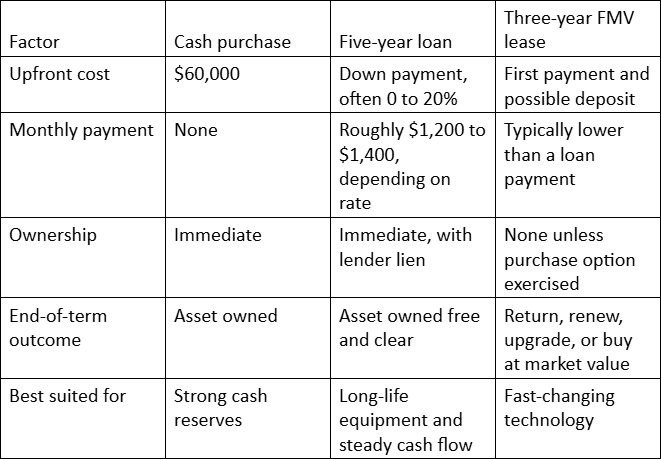
Figures are illustrative. Actual rates and terms vary by lender, credit profile, and equipment type.
Research Before You Commit
Equipment financing offers can look similar at first glance, yet differ substantially in total cost, end-of-term conditions, insurance requirements, and fees. Take time to understand the market before choosing a provider.
Comparison resources like Compare Small Business Loans can help you weigh equipment loans against leases and other options. Review platforms such as Best Rated Business Loans offer perspective on how different providers are rated by business owners. For a sense of which companies focus on equipment financing in particular industries, directories like Business Loans Companies can be useful, and Merchant Guidance provides practical context on how financing decisions affect day-to-day cash management.
When reviewing offers, ask:
- What is the total cost over the full term, including all fees?
- Is the rate fixed or variable?
- What happens at the end of a lease, and how is fair market value determined?
- Are there penalties for early payoff or early lease termination?
- Who is responsible for maintenance, insurance, and repairs?
- Does the agreement include an automatic renewal clause?
Apply With the Best Fit, Not With Everyone
After your research, select the one provider that best matches your equipment, budget, and timeline, and apply there. Submitting applications to many lenders and leasing companies simultaneously can lead to multiple hard credit inquiries, which may lower your score and cause underwriters to question your financial stability. It can also flood you with competing calls and quotes, making a careful comparison harder rather than easier.
A single, complete application, including the equipment quote, recent bank statements, and financial statements, typically moves faster and receives more thoughtful attention. If the outcome is not what you need, ask what would improve your chances and approach your next choice with that insight.
New or Used?
Financing is not limited to brand-new equipment. Many lenders finance used machinery, vehicles, and tools, often at a lower total cost. Used equipment can make sense when the asset is durable, well maintained, and available with service records. The trade-offs include shorter remaining life, possibly higher interest rates, shorter loan terms, and limited or no warranty coverage. Ask for an independent inspection on high-value used purchases, and confirm whether the lender requires an appraisal. For some businesses, a reliable used machine financed over three years is a smarter move than a new one stretched over seven.
Common Equipment Financing Mistakes
- Financing equipment longer than its useful life. You may still be making payments after it stops working.
- Ignoring end-of-lease terms. Surprise buyout prices or return conditions can be costly.
- Overlooking soft costs. Delivery, installation, and training may not be covered by every provider.
- Skipping the tax conversation. The wrong structure can mean leaving deductions on the table.
- Buying more capacity than you need. Bigger is not always better if the extra capacity sits idle while payments continue every month.
The Bottom Line
Equipment is one of the most important investments a business makes, and the way you finance it shapes your cash flow for years. Think through how long the equipment will be useful, how it will generate returns, and whether flexibility or ownership matters more. Research providers carefully, then apply with the one that fits your situation best. A thoughtful decision today keeps your business productive and financially healthy long after the equipment is installed and the final payment has been made.