By Rebecca Sterling
Rock and roll has always promised liberation, though it has never been particularly clear about what happens after we’re liberated. Freedom from convention? From sexual repression? From other people’s expectations? From ourselves? Popular music has spent decades selling rebellion as a commodity, turning emotional disorder into something attractive, marketable and ultimately reassuring. The trouble is that actual human experience rarely cooperates with such tidy arrangements.
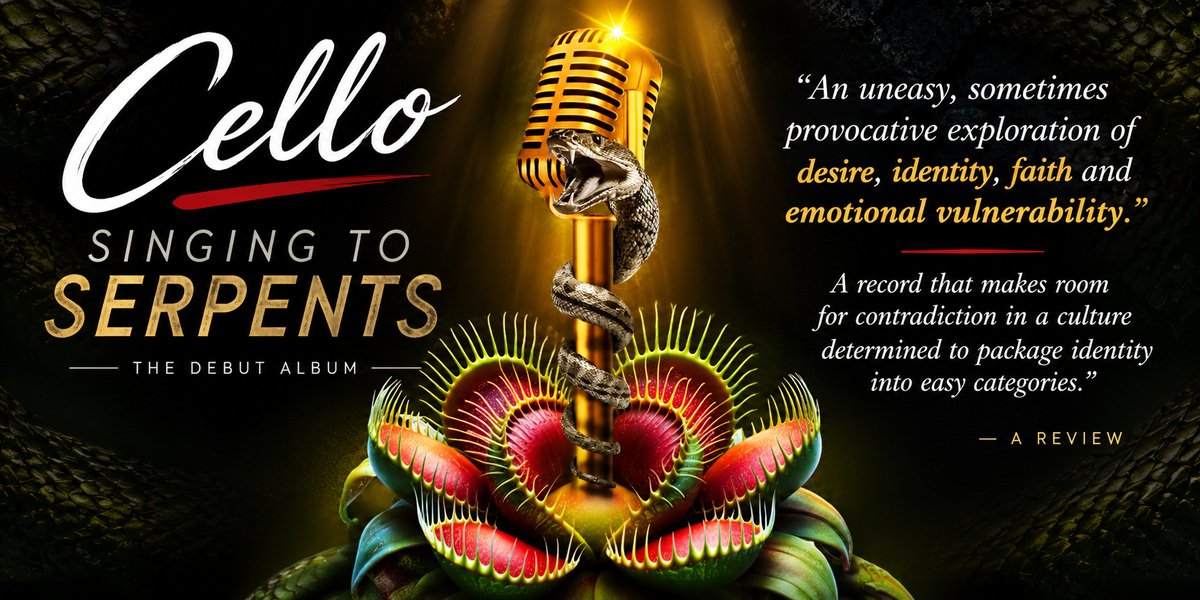
Pittsburgh singer-songwriter Cello seems to understand this contradiction. His album Singing to Serpents is an uneasy, sometimes provocative exploration of desire, identity, faith and emotional vulnerability. It isn’t especially interested in presenting a perfected version of its creator. Instead, it exposes the confusion that conventional pop music frequently disguises beneath catchy choruses and carefully manufactured confidence.
That makes it worth taking seriously.
Across nine tracks, Cello moves between alternative pop, hip-hop-influenced phrasing, atmospheric arrangements and confessional songwriting. The stylistic combinations aren’t always seamless, but their unpredictability reflects the album’s central preoccupation: the difficulty of constructing a coherent identity from contradictory feelings.
The opening track, “Stay Here,” begins with one of popular music’s oldest propositions. Someone wants another person to remain. Love songs have traditionally romanticized this desperation, treating emotional dependence as evidence of devotion. Cello’s approach invites a more uncomfortable interpretation.
What happens when affection becomes possession? When the desire for intimacy begins to resemble a fear of abandonment? When asking someone to stay reveals more about our insecurity than our love?
These questions complicate the song’s emotional appeal. Its vulnerability is compelling precisely because it isn’t necessarily innocent.
“Elevate” introduces another familiar pop convention: the declaration of personal empowerment. Yet confidence is never entirely convincing when it must be repeatedly announced. Cello’s ambition feels genuine, but so does the uncertainty beneath it. The tension exposes a fundamental problem with contemporary self-improvement culture, which insists that individuals overcome insecurity through sufficient determination.
Human beings, unfortunately, are more complicated than motivational slogans.
On “Sucks to Be Used,” the emotional terrain becomes angrier. Betrayal and resentment provide the song’s dramatic foundation, but the larger question concerns the relationship between victimhood and power. Being wounded doesn’t automatically make someone wise. Anger can be justified while remaining destructive.
Cello’s willingness to inhabit these contradictions prevents the album from becoming another predictable exercise in therapeutic self-congratulation.
The middle section, including “Full Moon,” “So Long,” and “Cravings,” examines the relationship between desire and personal autonomy. Popular music has historically celebrated appetite as liberation, particularly when rejecting restrictive social expectations. But desire isn’t automatically freedom. Sometimes it creates dependencies every bit as confining as the conventions it challenges.
This is where Singing to Serpents becomes most interesting.
Cello doesn’t simply celebrate emotional intensity. He questions its consequences. His songs suggest that wanting something passionately and wanting something wisely are entirely different propositions.
The album’s title reinforces this ambiguity. Serpents have traditionally represented temptation, danger, knowledge and transformation. Rather than imagining himself destroying these symbolic threats, Cello chooses to sing to them.
The distinction matters. Liberation may require confronting uncomfortable truths rather than pretending they can be eliminated.
Cello’s experience as an autistic artist with ADHD adds another dimension to these questions. He has spoken openly about neurodivergence and the challenges of communicating emotions, navigating relationships, and pursuing creative ambitions in environments structured around conventional expectations.
Yet interpreting his music exclusively through autism and ADHD would be a mistake. His neurodivergence informs his perspective without determining the meaning of every artistic decision.
The more important issue is autonomy.
Who gets to define what constitutes appropriate emotional expression? Who decides which forms of communication are legitimate? Why should conformity be mistaken for psychological health?
These questions extend beyond disability into the larger politics of individuality and social acceptance.
Cello’s commitment to autism advocacy, including his ambition to become a certified peer support professional, suggests that his interest in self-expression isn’t merely personal. He wants to translate lived experience into meaningful support for others.
That goal gives his artistic work a social dimension without requiring every song to become a political statement.
The album’s spiritual turn arrives through “Pray” and “Faith,” two songs that introduce another complicated institution into the discussion: religion.
Popular music has frequently treated faith either as unquestionable salvation or oppressive authority. Cello’s approach occupies less convenient territory. Belief emerges as a response to uncertainty rather than proof that uncertainty has disappeared.
There’s something appealing about this refusal to resolve the conflict between independence and surrender. Faith can provide comfort, but it also raises difficult questions about authority, responsibility, and the desire to escape personal doubt.
Cello doesn’t fully settle those questions.
He shouldn’t have to.
The closing “Sleeping” offers a quieter conclusion without pretending that emotional conflict has been permanently defeated. The album ends not with triumphant self-mastery but with the recognition that human beings remain unfinished.
This is ultimately the strongest argument for Singing to Serpents.
Its significance doesn’t depend on technical perfection, stylistic innovation, or the promise that Cello has discovered some revolutionary psychological truth. The album’s achievement is more modest and arguably more valuable: it makes room for contradiction in a culture increasingly determined to package identity into easily recognizable categories.
Cello can be vulnerable without being helpless, ambitious without being certain, spiritual without possessing every answer, and neurodivergent without allowing that identity to exhaust his artistic possibilities.
There are moments when the record’s emotional intensity threatens to overwhelm its musical discipline. A more restrained approach might occasionally sharpen the impact. But excessive neatness would also undermine the very experience Cello is attempting to communicate.
Singing to Serpents isn’t a manifesto for overcoming one’s demons. It is an argument for acknowledging their existence without surrendering one’s humanity.
And perhaps that’s a more useful definition of liberation than popular music usually offers: not the fantasy of becoming someone without contradictions, but the freedom to recognize them, question them, and continue creating anyway.