By PilatesBridge Editorial Staff
Pilates has become one of the hottest trends in fitness. Reformer classes are no longer limited to dedicated Pilates studios, with many gyms and health clubs now adding Reformer-based classes to their schedules. On the Upper East Side and across Manhattan, Pilates classes now range from highly personalized instruction to large group Reformer workouts with ten, twenty, or even thirty people moving through the same sequence.
For plenty of people, that works.
But there is another group quietly looking for something different.
They are not necessarily beginners. They are not necessarily injured. They may be experienced exercisers, older adults, athletes, or people who simply want to understand what they are doing instead of following along with the room.
For them, the size of the class can change the entire experience.
The Problem Is Not the Reformer
The Reformer was never meant to exist in isolation.
In Classical Pilates, it is one part of a much larger system that also includes the Mat, Cadillac, Chairs, Barrels, and other apparatus developed to address different needs within the body.
That matters because the original Pilates method was never built around the idea that everyone should do the same workout at the same time. The exercises were added to progress the student or work on their specific needs that day, rather than make them feel “the burn”.
Jennifer Ruggiero, founder of The Pilates Movement, has built her approach around smaller, more personalized Classical Pilates instruction. At her studio offering Pilates on the Upper East Side, that means looking beyond the exercise itself and paying close attention to how each client moves, responds, and progresses.
“Classical Pilates teachers are able to put together a well-designed program for anyone,” she explains. “We are taught to use the entire studio and all of the apparatus depending on what the person in front of us needs.”
That same approach carries through to The Pilates Movement’s Westchester location, where Pilates in Tarrytown is taught with the same emphasis on individual attention, thoughtful progression, and the full Classical Pilates system.
That sounds simple, but it is almost impossible to do meaningfully when one instructor is responsible for a room full of people.
Everyone Doing the Same Thing Is Not Really Personalization
Large group fitness depends on standardization. It has to.
The instructor needs to lead a workout that moves at a predictable pace and works reasonably well for most people in the room.
The problem starts when “most people” becomes the goal.
One client may need more resistance. Another may need less. One may need to work on balance. Another may need to avoid a particular movement altogether. Someone who has been practicing Pilates for years may need a more advanced progression, while the person next to them is still learning the foundation.
Giving everyone the same workout and offering a few modifications around the edges does not fully solve that problem.
Ruggiero sees this frequently in large classes.
“Teachers may give modifications, and most people tend not to take them even when they should because they are trying to keep up with the people around them,” she says.
There is often a psychological component too. Taking a lighter spring or skipping an exercise can feel like falling behind.
Ruggiero sees it differently.
“Changing an exercise to fit your body today isn’t a punishment. It is creating an intelligent mover.”
That may be one of the biggest differences between working out and practicing Pilates.
Small Classes Create Room for Decisions
The advantage of a smaller Pilates class is not simply that the room feels more intimate.
It is that the teacher can actually make decisions.
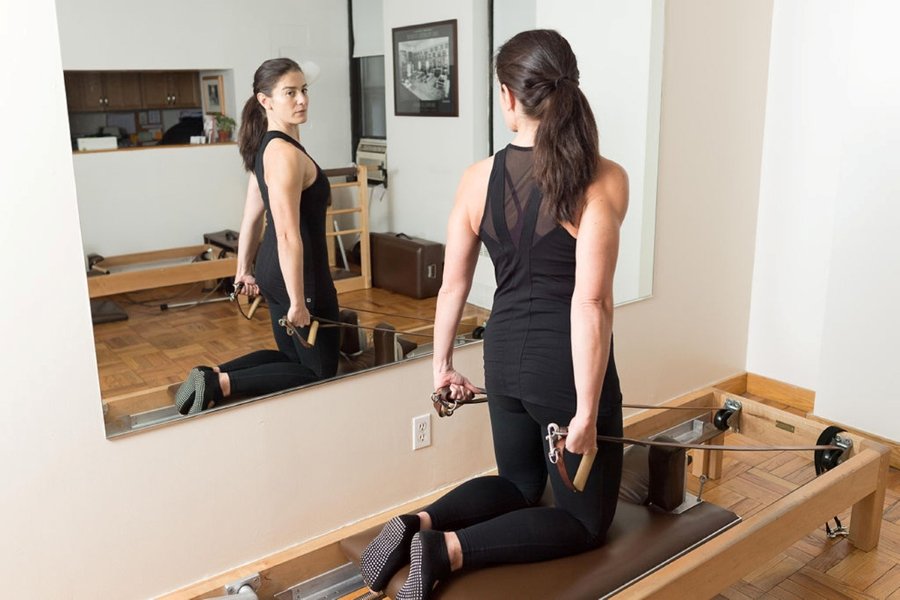
An instructor can watch how someone moves, notice whether there is ease or strain, adjust resistance, change an exercise, or give a more challenging variation to someone who is ready for it.
In a small group, two people can technically be taking the same class while receiving very different instruction.
That becomes particularly important for people whose needs are more specific.
The Pilates Movement offers personalized small group Pilates classes in the Upper East Side of Manhattan and Tarrytown for clients with different experience levels, movement histories, and physical needs.
For clients with osteoporosis, joint concerns, chronic pain, balance challenges, or other diagnosed conditions, Ruggiero emphasizes the importance of knowing exactly what the instructor is working with.
“You have to meet the person where they are in the present moment,” she says. “Today, not yesterday.”
That last part is easy to underestimate.
Bodies change from one session to the next. Sleep, stress, pain, recovery, and previous activity can all influence what makes sense on a particular day.
A good Pilates session accounts for that.
Beginners Are Not the Only People Who Need Attention
There is a common assumption that personalization matters most when someone is new and looking for beginner Pilates, recovering from an injury, or dealing with any health conditions.
Experienced clients can need it just as much.
A seasoned Pilates practitioner or conditioned athlete may reach a point where a general class stops challenging them. If the instructor has to keep the entire room moving together, there may be little opportunity to introduce more complex work or change the apparatus to address specific goals.
“They might find their fitness level plateaus because the class isn’t challenging enough for them,” Ruggiero says.
This is one of the less discussed limitations of large group Pilates.
The issue is not always that the class is too difficult.
Sometimes it is not specific enough.
Classical Pilates Was Designed to Progress
This is where Classical Pilates becomes particularly relevant.
The method contains established progressions. Exercises build upon earlier exercises. The Mat and Reformer follow specific sequences, while other apparatus can be introduced based on what the individual needs.
Progress is not simply about adding harder exercises.
It is about knowing when someone has earned the next step.
“We only progress someone once they are able to understand the exercises that came prior,” Ruggiero explains.
That requires an instructor who knows more than choreography.
Classically trained teachers study how exercises relate to one another, what each exercise is intended to develop, and where to go within the larger system when a client needs something different.
Ruggiero describes Pilates as a lifelong practice rather than a workout someone eventually masters.
“The practice changes as the person changes,” she says.
That may be why smaller classes appeal to people who want more than an hour of movement.
They create enough space for the practice to actually evolve.
Smaller Is Not Automatically Better
None of this means every large reformer class is ineffective or that everyone needs private Pilates.
Some people enjoy the energy of a bigger room. Others simply want an accessible workout and have no interest in a more individualized practice.
Private training also comes at a price that does not fit every budget.
Small group Pilates sits somewhere in the middle.
It offers the energy and accessibility of a group setting while giving the instructor enough room to observe, adjust, and progress each client more thoughtfully.
That distinction matters most when the goal is not simply to finish a workout, but to build a practice that responds to the body, changes over time, and continues to challenge the person doing it.
For clients who want that kind of experience, smaller classes can offer something that is difficult to replicate in a larger room: individual attention within a shared practice.