When it comes to Cesare Catania, one might immediately think of his stunning visual art, whether it be his vibrant paintings, intricate sculptures, or cutting-edge digital creations. Over the past decade, Catania has built a reputation as an artist who constantly evolves, exploring new forms and methods of expression. Now, in a remarkable leap, he’s ventured into the world of cinema with his short film The Imagination of a Child, a piece that captures both the heart and mind of an artist in the throes of creative development.
Catania’s film is much more than just a documentary or a narrative work of fiction. It stands as a hybrid—an artistic fusion that blends elements of both genres to produce something entirely new. The 15-minute short, which premiered in 2024, delves into the emotional and psychological journey of an artist, exploring how imagination, memory, and emotion intertwine to shape the artistic process. Set predominantly in Venice and Milan, The Imagination of a Child carries viewers through the delicate layers of creativity, offering insights into the mental and emotional state of an artist as he navigates the challenges and joys of creation.
Catania’s approach to the film as director, as artistic director, as writer and as co-director of photography is as unconventional as his overall artistic journey. The Imagination of a Child is mostly silent, filmed in stark black and white, a visual style that recalls early cinema while stripping the work of any distractions that might come from spoken dialogue or vibrant color. Instead, Catania relies on the sheer power of imagery and the written reflections of the film’s narrator—an abstract figure whose thoughts guide the viewer through the unfolding scenes. The artist’s decision to forgo traditional storytelling techniques, such as dialogue or narration, enhances the viewer’s immersion into the artist’s world, leaving the audience to experience the art in its rawest form.
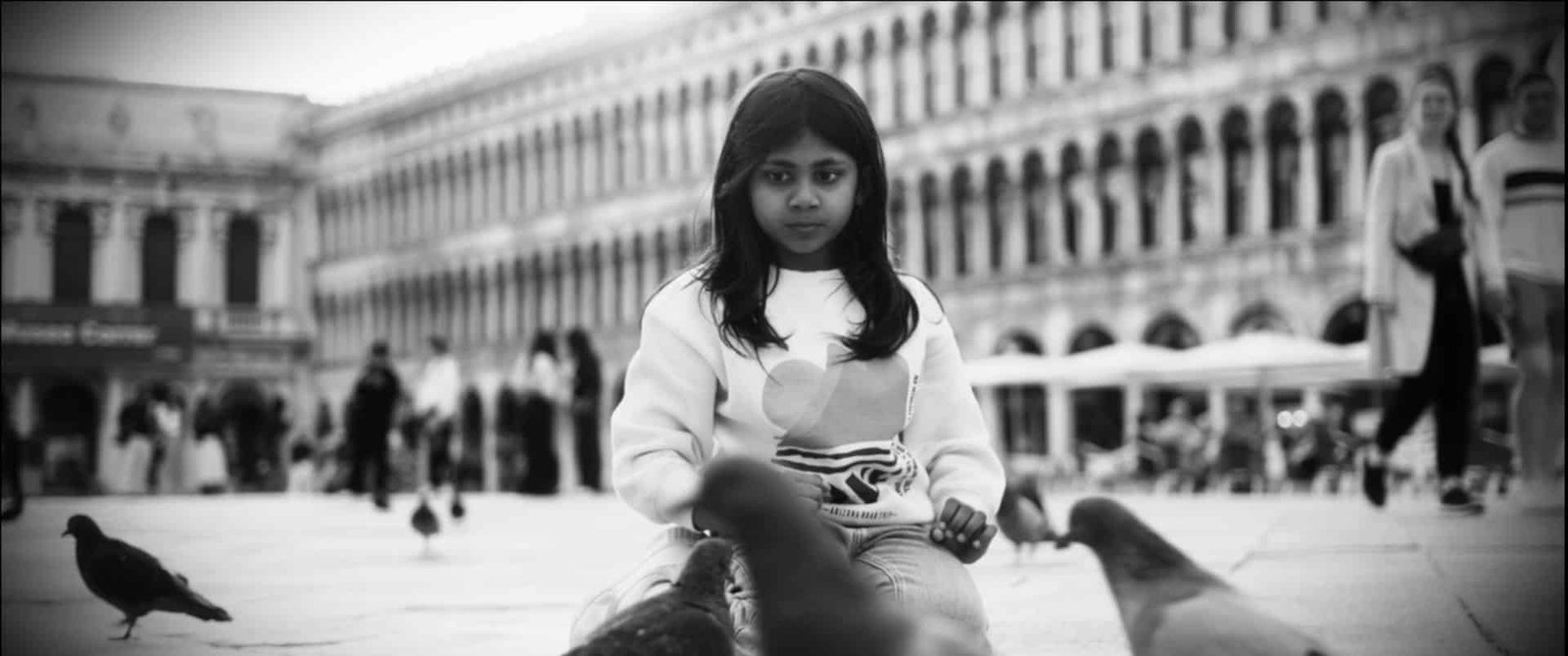
At its core, The Imagination of a Child tells the story of two seemingly different individuals: an Italian sculptor, representing Cesare Catania himself, and a young Sri Lankan girl, who lives in Italy with her family. The two protagonists are connected by an overwhelming passion for art, though at first, their lives seem worlds apart. The sculptor is a seasoned artist, grappling with the complexities of adulthood and creative maturation, while the girl represents youthful innocence and unfiltered imagination, viewing the world with fresh, untainted eyes.
As the film progresses, the connection between the two characters deepens. What begins as a simple narrative about the creation of a sculpture soon evolves into something much more profound. The girl, though young, displays a striking ability to understand and engage with the artistic process, mirroring the sculptor’s own internal struggles. The pivotal moment of the film comes when it’s revealed that the two characters are, in fact, the same person. This twist speaks volumes about the underlying theme of the film: the idea that the artist must look at the world through two lenses—those of an adult and those of a child. To create meaningful art, one must combine the wisdom and experience of maturity with the wonder and creativity of a youthful imagination.

Catania has explained that this dual perspective is central not only to the film but to his own personal philosophy as an artist. “It doesn’t matter which expressive medium I use to convey my emotions. What matters is that inspiration is transferred in the most pure and genuine way,” he has said. For Catania, this purity can only be achieved by maintaining a childlike sense of wonder while also embracing the reflective, analytical perspective that comes with adulthood. In The Imagination of a Child, the artist manages to depict this delicate balance, showing how an artist can be both a creator and a dreamer.
What sets this film apart from more conventional artistic documentaries is Catania’s deliberate choice to focus on inclusivity and the breaking down of cultural barriers. The fact that the young girl is of Sri Lankan descent is not coincidental. This narrative choice aligns perfectly with the overarching theme of the 2024 Venice Biennale, titled “Foreigners Everywhere,” which seeks to explore the cultural and societal dynamics of migration, identity, and belonging. Through the film’s plot, Catania highlights the importance of embracing diverse perspectives, not only within the world of art but in life itself. The connection between the sculptor and the girl illustrates how different cultures and generations can intersect through shared human experiences like art.
Beyond its symbolic narrative, the film is also deeply personal for Catania. It serves as a companion piece to his monumental sculpture, The Embrace, which is prominently featured in the short film and has become a central piece of the artist’s broader body of work. The sculpture, created in 2023, represents themes of unity, peace, and the breaking down of cultural barriers—concepts that are at the very heart of The Imagination of a Child. In the film, the creation of the sculpture becomes a metaphor for the artist’s own journey of self-discovery and reflection, as well as a symbol of the unity between the sculptor and the girl.
Catania’s cinematic foray is also part of his larger project, known as the Embrace Project. Launched in 2023, the project aims to promote peace and inclusivity through art, with a particular focus on highlighting the role of art as a means of communication and understanding. The project’s namesake sculpture, The Embrace, serves as a recurring motif in Catania’s work, symbolizing his commitment to using art as a tool for positive social change. Through the Embrace Project, Catania was named the global ambassador for National Hugging Day in 2023, a role that allowed him to further spread his message of unity and empathy.
The artistic value of The Imagination of a Child has already been recognized on the international stage. The short film has garnered numerous accolades at prestigious film festivals, spanning continents from Europe to Asia and North America. While Catania is humble about the attention the film has received, preferring to let the work speak for itself, it’s clear that his foray into cinema has struck a chord with both critics and audiences alike.
What makes this transition from visual art to cinema so seamless for Catania is his deep-rooted passion for storytelling and his understanding of visual composition. In a recent interview, the artist explained that cinema feels like a natural evolution of his work as a painter and sculptor. “I have always had a deep love for artistic photography, and my first professional painting experiences began with the intent of capturing my emotions and the reality around me on canvas. I then developed my art through a digital journey, with the main goal of providing my works with the dynamism and movement that only kinetic and digital art could offer,” he explained. For Catania, the jump to film wasn’t a leap but a gradual progression. “When I make a film, I conceive of it as an infinite sum of countless frames, each of which must be an independent photograph that, thanks to the previous and subsequent frames, becomes a moving image,” he said.
Ultimately, what makes The Imagination of a Child stand out is not just the film’s modern structure or its beautiful cinematography, but the way in which it challenges viewers to reflect on the nature of art, identity, and creativity. Through this short film, Cesare Catania has once again proven himself to be an artist who refuses to be confined by the traditional limits of any single medium, demonstrating that art—whether on canvas, in sculpture, or on film—remains a powerful tool for exploring the human experience.
In the latest cinematic endeavor, “The Imagination of a Child”, Cesare Catania takes the helm as both the Director of the Film, the Artistic Director and a lead actor, sharing the screen with Christine Fernando, one of the film’s protagonists. The film’s visual storytelling is brought to life through the collaborative efforts of Lorenzo Massa and Cesare Catania, who served as Co-Directors of Photography. The stunning visuals are complemented by the artistry of Stefano Bosatelli, who skillfully handled the editing. Under the guidance of Anastasiya Vrublevskaya, the Production Manager, the project was meticulously organized, ensuring a smooth production process.
Published by: Khy Talara